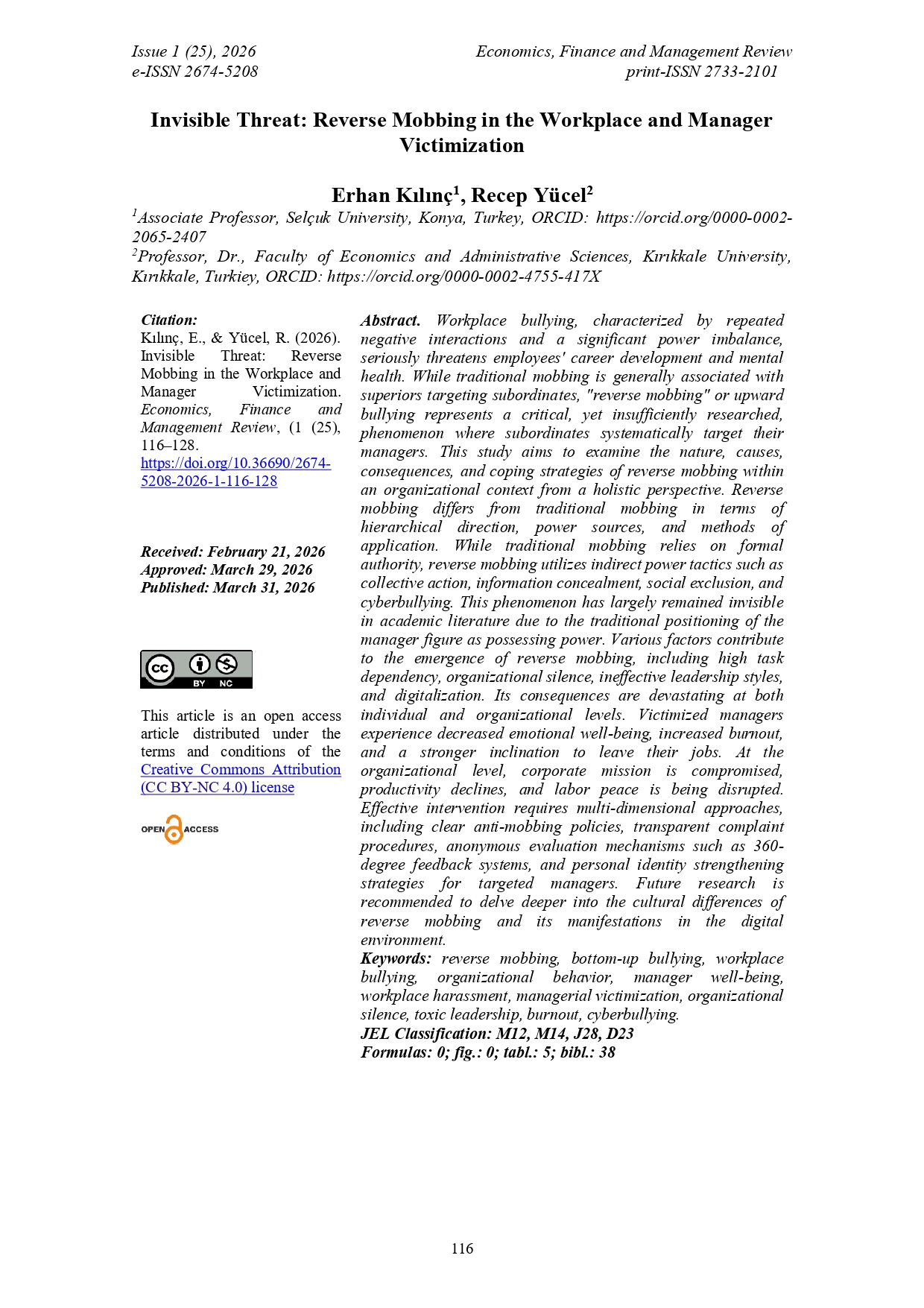
Invisible Threat: Reverse Mobbing in the Workplace and Manager Victimization
DOI:
https://doi.org/10.36690/2674-5208-2026-1-116-128Keywords:
reverse mobbing, bottom-up bullying, workplace bullying, organizational behavior, manager well-being, workplace harassment, managerial victimization, organizational silence, toxic leadership, burnout, cyberbullyingAbstract
Workplace bullying, characterized by repeated negative interactions and a significant power imbalance, seriously threatens employees' career development and mental health. While traditional mobbing is generally associated with superiors targeting subordinates, "reverse mobbing" or upward bullying represents a critical, yet insufficiently researched, phenomenon where subordinates systematically target their managers. This study aims to examine the nature, causes, consequences, and coping strategies of reverse mobbing within an organizational context from a holistic perspective. Reverse mobbing differs from traditional mobbing in terms of hierarchical direction, power sources, and methods of application. While traditional mobbing relies on formal authority, reverse mobbing utilizes indirect power tactics such as collective action, information concealment, social exclusion, and cyberbullying. This phenomenon has largely remained invisible in academic literature due to the traditional positioning of the manager figure as possessing power. Various factors contribute to the emergence of reverse mobbing, including high task dependency, organizational silence, ineffective leadership styles, and digitalization. Its consequences are devastating at both individual and organizational levels. Victimized managers experience decreased emotional well-being, increased burnout, and a stronger inclination to leave their jobs. At the organizational level, corporate mission is compromised, productivity declines, and labor peace is being disrupted. Effective intervention requires multi-dimensional approaches, including clear anti-mobbing policies, transparent complaint procedures, anonymous evaluation mechanisms such as 360-degree feedback systems, and personal identity strengthening strategies for targeted managers. Future research is recommended to delve deeper into the cultural differences of reverse mobbing and its manifestations in the digital environment.
Downloads
References
Ahmad, S., Kalim, R., & Kaleem, A. (2017). Academics’ perceptions of bullying at work: Insights from Pakistan. International Journal of Educational Management, 31(2), 204–220. https://doi.org/10.1108/IJEM-10-2015-0141
Ay, F. A. (2025). Workplace mobbing as a form of serious workplace conflict: A bibliometric analysis of studies from 1990 to 2024. Trauma, Violence, & Abuse. Advance online publication. https://doi.org/10.1177/15248380251349772
Aristotelis, K., Emmanouil, V., Fotini, T., & Styliani, T. (2018). Group experiential intervention in Greek health professionals for the confrontation of mobbing. Occupational and Environmental Medicine, 75, A99–A100.
Babanov, S., & Lysova, M. (2025). Problems of psychological harassment in the work team: Mobbing as a professional risk factor. Glavvrač (Chief Medical Officer).
Babanov, S., Lysova, M., Ostryakova, N., & Babanov, A. (2025). Moral and ethical aspects of mobbing and organizational and managerial means of its prevention in organized labor collectives. Glavvrač (Chief Medical Officer).
Belwal, R., Al Fazari, M., & Mansour, S. (2025). Women working in public and private sector organisations in Oman: Are they free to glide? Equality, Diversity and Inclusion: An International Journal, 45(1), 117–145.
Bokovets, O., & Zhukova, A. (2023). Social prevention of mobbing in the workplace. Visnyk of Lviv University. Series Pedagogics.
Bracken, D. W. (2026). 360 degree feedback. In V. Ratten (Ed.), International encyclopedia of business management (pp. 614–621). Academic Press.
Branch, S., Ramsay, S., & Barker, M. (2013). Workplace bullying, mobbing and general harassment: A review. International Journal of Management Reviews, 15(3), 280–299. https://doi.org/10.1111/j.1468-2370.2012.00339.x
Dadaboyev, S., Park, J., & Ahn, S. I. (2019). Dark sides of self-efficacy and task interdependence: Victimization. Journal of Managerial Psychology, 34(6), 386–400. https://doi.org/10.1108/JMP-01-2018-0033
Duffy, M. (2009). Preventing workplace mobbing and bullying with effective organizational consultation, policies, and legislation. Consulting Psychology Journal: Practice and Research, 61(3), 242–262.
Durniat, K. (2021). Methodological, ethical and legal problems of measuring and counteracting workplace mobbing. In Ethics of psychological assessment in organizations.
Elçi, M., Erdilek Karabay, M., Alpkan, L., & Şener, İ. (2014). The mediating role of mobbing on the relationship between organizational silence and turnover intention. Procedia - Social and Behavioral Sciences, 150, 455–464. https://doi.org/10.1016/j.sbspro.2014.09.053
Faria, J. R., Mixon, F. G., & Salter, P. S. (2012). An economic model of workplace mobbing in academe. Economics of Education Review, 31(5), 720–726. https://doi.org/10.1016/j.econedurev.2012.04.004
Fry, A., & Schmer, C. (2021). Nursing faculty bullying: Concept analysis. Journal of Professional Nursing, 37(6), 1197–1202. https://doi.org/10.1016/j.profnurs.2021.11.001
Gembalska-Kwiecień, A. (2020). Mobbing prevention as one of the challenges of a modern organization. Scientific Papers of Silesian University of Technology. Organization and Management Series.
Grotto-De-Souza, J., Pohl, H., & Aguiar-Ribeiro, D. (2023). Mobbing as a source of psychological harm in workers. Revista Brasileira de Medicina do Trabalho, 20(4), 670–675. https://doi.org/10.47626/1679-4435-2022-766
Ladyk, V. (2022). Workplace mobbing: How to combat violence at work. Perspectives. Socio-political Journal.
Leymann, H. (1996). The content and development of mobbing at work. European Journal of Work and Organizational Psychology, 5(2), 165–184. https://doi.org/10.1080/13594329608414853
Livak, N., Savel’eva, T., Portnyagina, A., Desyatova, I., & Bolsunovskaya, E. (2025). Prevention of mobbing in service groups. Konfliktologiya / Nota Bene.
Mintz-Binder, R. D., & Calkins, R. D. (2012). Exposure to bullying at the associate degree nursing program director level. Teaching and Learning in Nursing, 7(4), 152–158. https://doi.org/10.1016/j.teln.2012.04.003
Mishra, S., Chaudhuri, M., & Dey, A. K. (2021). Deflating power imbalance through personal identity enhancement. Qualitative Research in Organizations and Management: An International Journal, 16(1), 98–126. https://doi.org/10.1108/QROM-03-2020-1902
Myshchyshyn, I., & Tsiura, S. (2025). Mobbing in the professional environment: An analysis of its causes and managerial strategies for prevention. Visnyk of Lviv University. Series Pedagogics.
Ramos Salazar, L., Weiss, A., Yarbrough, J. W., & Sell, K. M. (2024). Cyberbullying of university faculty: An examination of prevalence, coping, gender, and personality factors. Computers in Human Behavior, 155, Article 108186. https://doi.org/10.1016/j.chb.2024.108186
Resch, M., & Schubinski, M. (1996). Mobbing: Prevention and management in organizations. European Journal of Work and Organizational Psychology, 5, 295–307.
Ribeiro, N., Semedo, A. S., Gomes, D., Bernardino, R., & Singh, S. (2021). The effect of workplace bullying on burnout: The mediating role of affective well-being. Management Research Review, 45(6), 824–840. https://doi.org/10.1108/MRR-07-2021-0514
Russo, A., Borovac Zekan, S., & Peronja, I. (2012). Use of anonymous questionnaires with the aim of improving interpersonal relationships in work environment. Procedia - Social and Behavioral Sciences, 41, 492–497.
Theodoratou, M., Fasoulas, A., Farmakopoulou, I., Flora, K., Tsitsas, G., & Kougioumtzis, G. (2022). Coping strategies towards mobbing used by medical and nursing staff in the hospitals of the prefecture of Etoloakarnania, Greece. European Psychiatry, 65, S882–S883.
Uysal, H. (2016). Employees’ leadership perception and reverse mobbing tendency: The effect of employee-oriented leadership. The Journal of International Social Research, 9(45), 933–943. https://doi.org/10.17719/jisr.2016.1441
Uysal, H. T., & Yavuz, K. (2013). The invisible face of mobbing in organizations: Reverse mobbing. Turkish Studies, 8(8), 527–542.
Václavíková, K., Šoukalová, K., Kopecký, M., & Molnárová, L. (2023). Preventing mobbing of nurses: A scoping review. Central European Journal of Nursing and Midwifery.
Vveinhardt, J., & Deikus, M. (2023). Strategies for a nonviolent response to perpetrator actions: What can Christianity offer to targets of workplace mobbing? Scientia et Fides.
Vveinhardt, J., & Sroka, W. (2020). Innovations in human resources management: Instruments to eliminate mobbing. Marketing and Management of Innovations.
Williams, K. R. (2018). Toxic leadership in defense and federal workplaces: Sabotaging the mission and innovation. International Journal of Public Leadership, 14(3), 179–198. https://doi.org/10.1108/IJPL-04-2018-0023
York, T. W. (2026). Violence in healthcare. In T. W. York (Ed.), Hospital and healthcare security (pp. 581–621). Butterworth-Heinemann.
Yu, Y., Xu, S., Li, G., & Kong, H. (2020). A systematic review of research on abusive supervision in hospitality and tourism. International Journal of Contemporary Hospitality Management, 32(7), 2473–2496.
Zapf, D. (1999). Organisational, work group related and personal causes of mobbing/bullying at work. International Journal of Manpower, 20(1/2), 70–85. https://doi.org/10.1108/01437729910268669
Zapf, D., & Gross, C. (2001). Conflict escalation and coping with workplace bullying: A replication and extension. European Journal of Work and Organizational Psychology, 10, 497–522.
Zapf, D., & Leymann, H. (2024). Mobbing and victimization at work. Routledge.
Downloads
Published
How to Cite
Issue
Section
License

This work is licensed under a Creative Commons Attribution-NonCommercial 4.0 International License.