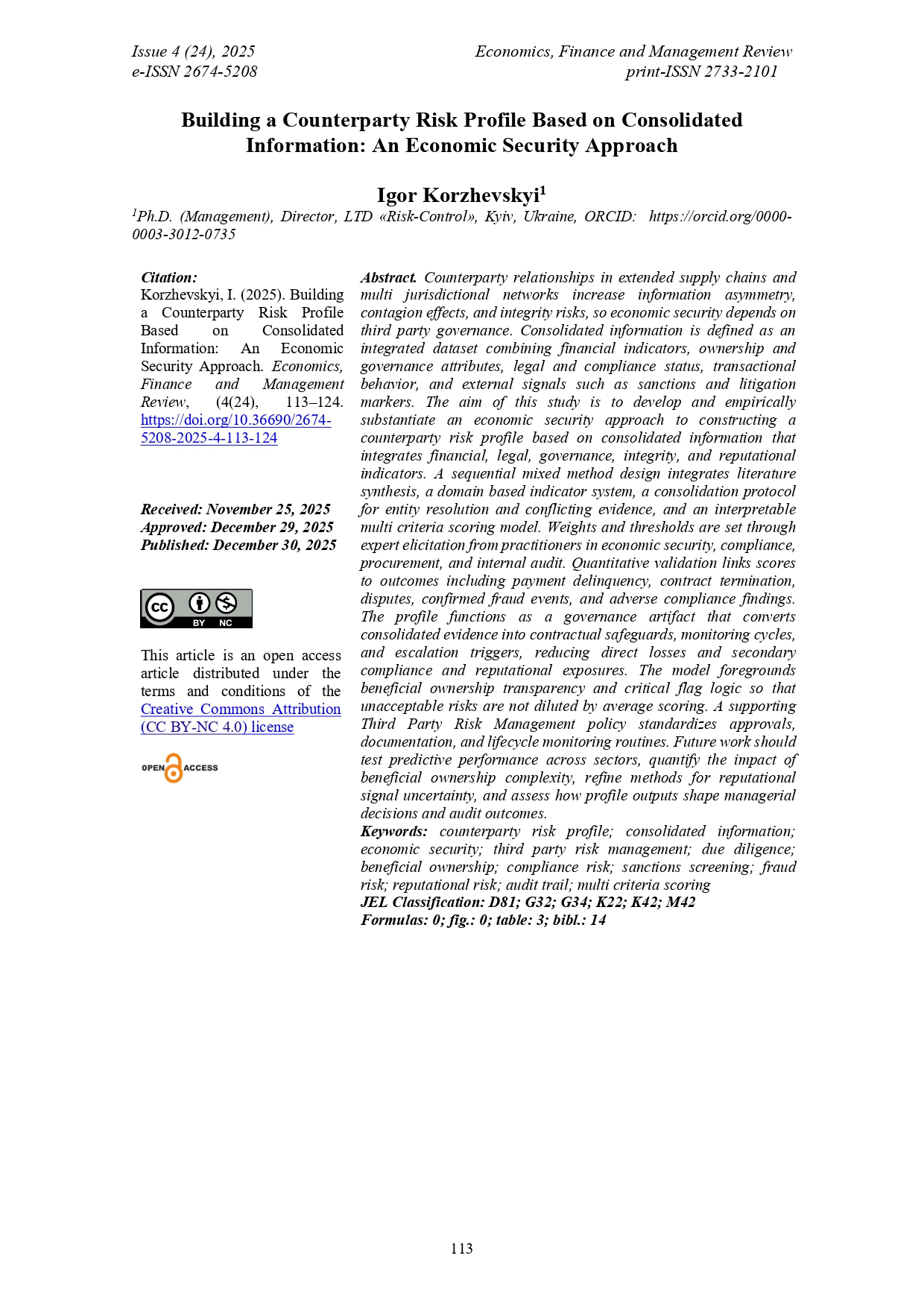
Building a Counterparty Risk Profile Based on Consolidated Information: An Economic Security Approach
DOI:
https://doi.org/10.36690/2674-5208-2025-4-113-124Keywords:
counterparty risk profile, consolidated information, economic security, third party risk management, due diligence, beneficial ownership, compliance risk, sanctions screening, fraud risk, reputational risk, audit trail, multi criteria scoringAbstract
Counterparty relationships in extended supply chains and multi jurisdictional networks increase information asymmetry, contagion effects, and integrity risks, so economic security depends on third party governance. Consolidated information is defined as an integrated dataset combining financial indicators, ownership and governance attributes, legal and compliance status, transactional behavior, and external signals such as sanctions and litigation markers. The aim of this study is to develop and empirically substantiate an economic security approach to constructing a counterparty risk profile based on consolidated information that integrates financial, legal, governance, integrity, and reputational indicators. A sequential mixed method design integrates literature synthesis, a domain based indicator system, a consolidation protocol for entity resolution and conflicting evidence, and an interpretable multi criteria scoring model. Weights and thresholds are set through expert elicitation from practitioners in economic security, compliance, procurement, and internal audit. Quantitative validation links scores to outcomes including payment delinquency, contract termination, disputes, confirmed fraud events, and adverse compliance findings. The profile functions as a governance artifact that converts consolidated evidence into contractual safeguards, monitoring cycles, and escalation triggers, reducing direct losses and secondary compliance and reputational exposures. The model foregrounds beneficial ownership transparency and critical flag logic so that unacceptable risks are not diluted by average scoring. A supporting Third Party Risk Management policy standardizes approvals, documentation, and lifecycle monitoring routines. Future work should test predictive performance across sectors, quantify the impact of beneficial ownership complexity, refine methods for reputational signal uncertainty, and assess how profile outputs shape managerial decisions and audit outcomes.
Downloads
References
Association of Certified Fraud Examiners. (2024). Occupational fraud 2024: A report to the nations. https://www.acfe.com/-/media/files/acfe/pdfs/rttn/2024/2024-report-to-the-nations.pdf
Basel Committee on Banking Supervision. (2013). Principles for effective risk data aggregation and risk reporting (BCBS 239). Bank for International Settlements. https://www.bis.org/publ/bcbs239.pdf
Basel Committee on Banking Supervision. (2024). Guidelines for counterparty credit risk management. Bank for International Settlements. https://www.bis.org/bcbs/publ/d588.pdf
Committee of Sponsoring Organizations of the Treadway Commission. (2017). Enterprise risk management: Integrating with strategy and performance. https://www.coso.org/enterprise-risk-management
Financial Action Task Force. (2023). Beneficial ownership of legal persons. https://www.fatf-gafi.org/content/dam/fatf-gafi/guidance/Guidance-Beneficial-Ownership-Legal-Persons.pdf.coredownload.pdf
International Organization for Standardization. (2018). ISO 31000:2018 Risk management – Guidelines. https://www.iso.org/standard/65694.html ISO
International Organization for Standardization. (2021). ISO 37301:2021 Compliance management systems – Requirements with guidance for use. https://www.iso.org/standard/75080.html
Korzhevskyi, I. (2025). From Intuition to Evidence: A Five-Factor Competency Framework For Business-Reputation Assessment. Pedagogy and Education Management Review, (3(21), 4–16. https://doi.org/10.36690/2733-2039-2025-3-4-16
Korzhevskyi, I. (2023). Digital Reputation Analytics for Business Models. Business model innovation in the digital economy:monograph.OÜ Scientific Center of Innovative Research. 2023. 208p. pp. 152-172, DOI: https://doi.org/10.36690/BM-ID-EU-152-172
Korzhevskyi, I. (2025). Methodological Approaches To Assessing Corporate Reputation And Economic Security Of Enterprises. Economics, Finance and Management Review, (3(23), 106–118. https://doi.org/10.36690/2674-5208-2025-3-106-118
Korzhevskyi, I., & Mihus, I. (2022). BUSINESS REPUTATION OF ENTERPRISES: DEFINITIONS, STRUCTURE AND REPUTATION RISK MANAGEMENT. Economics, Finance and Management Review, (3), 89–99. https://doi.org/10.36690/2674-5208-2022-3-89
Mihus,I.(2025). Corporate Governance as a Mechanism of Control, Coordination, and Trust. In P. Kolisnichenko (Ed.),Insider threats and security in corporations.274p. (pp. 77-95). Scientific Center of Innovative Research. https://doi.org/10.36690/ITSC-77-95
Organisation for Economic Co-operation and Development. (2018). OECD due diligence guidance for responsible business conduct. OECD Publishing. https://www.oecd.org/content/dam/oecd/en/publications/reports/2018/02/oecd-due-diligence-guidance-for-responsible-business-conduct_c669bd57/15f5f4b3-en.pdf
Veh, A., Göbel, M., & Vogel, R. (2019). Corporate reputation in management research: A review of the literature and assessment of the concept. Business Research, 12(2), 315–353. https://doi.org/10.1007/s40685-018-0080-4
Downloads
Published
How to Cite
Issue
Section
License

This work is licensed under a Creative Commons Attribution-NonCommercial 4.0 International License.