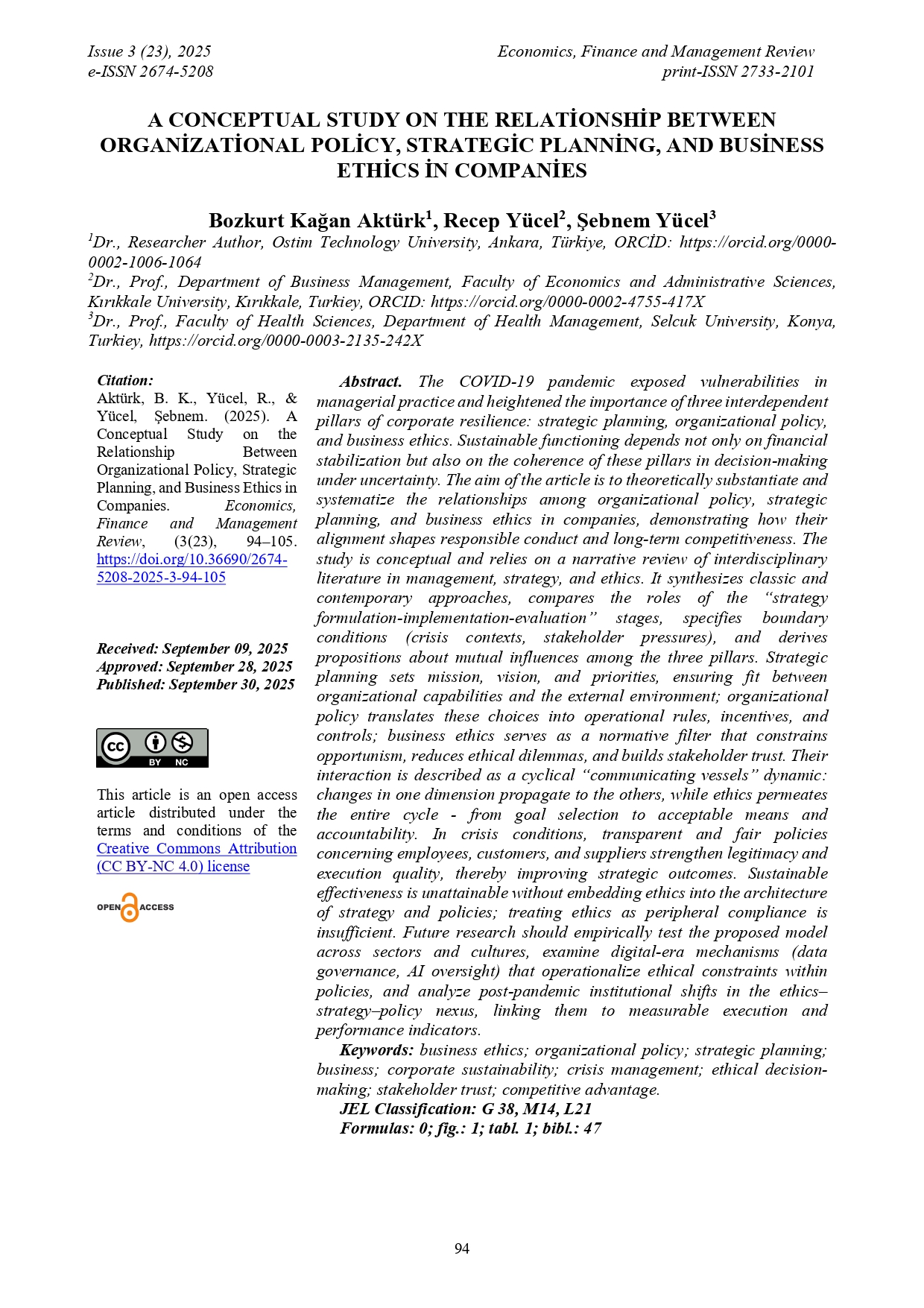
A CONCEPTUAL STUDY ON THE RELATİONSHİP BETWEEN ORGANİZATİONAL POLİCY, STRATEGİC PLANNİNG, AND BUSİNESS ETHİCS İN COMPANİES
DOI:
https://doi.org/10.36690/2674-5208-2025-3-94-105Keywords:
business ethics, organizational policy, strategic planning, business, corporate sustainability, crisis management, ethical decision-making, stakeholder trust, competitive advantageAbstract
The COVID-19 pandemic exposed vulnerabilities in managerial practice and heightened the importance of three interdependent pillars of corporate resilience: strategic planning, organizational policy, and business ethics. Sustainable functioning depends not only on financial stabilization but also on the coherence of these pillars in decision-making under uncertainty. The aim of the article is to theoretically substantiate and systematize the relationships among organizational policy, strategic planning, and business ethics in companies, demonstrating how their alignment shapes responsible conduct and long-term competitiveness. The study is conceptual and relies on a narrative review of interdisciplinary literature in management, strategy, and ethics. It synthesizes classic and contemporary approaches, compares the roles of the “strategy formulation—implementation—evaluation” stages, specifies boundary conditions (crisis contexts, stakeholder pressures), and derives propositions about mutual influences among the three pillars. Strategic planning sets mission, vision, and priorities, ensuring fit between organizational capabilities and the external environment; organizational policy translates these choices into operational rules, incentives, and controls; business ethics serves as a normative filter that constrains opportunism, reduces ethical dilemmas, and builds stakeholder trust. Their interaction is described as a cyclical “communicating vessels” dynamic: changes in one dimension propagate to the others, while ethics permeates the entire cycle—from goal selection to acceptable means and accountability. In crisis conditions, transparent and fair policies concerning employees, customers, and suppliers strengthen legitimacy and execution quality, thereby improving strategic outcomes. Sustainable effectiveness is unattainable without embedding ethics into the architecture of strategy and policies; treating ethics as peripheral compliance is insufficient. Future research should empirically test the proposed model across sectors and cultures, examine digital-era mechanisms (data governance, AI oversight) that operationalize ethical constraints within policies, and analyze post-pandemic institutional shifts in the ethics–strategy–policy nexus, linking them to measurable execution and performance indicators.
Downloads
References
Adıgüzel, M. (2020). Macroeconomic analysis of the effects of the Covid-19 pandemic on the Turkish economy. 19 (37), Spring (Special Supplement), 191-221.
Akat Ö. (2000). Business Policy and Strategic Marketing for Application. 2nd Edition, Ekin Publishing House.
Akgemci, T. (2015). Strategic Management, 4th Edition, Gazi Publishing House
Aktürk B.K. (2017). A research on the impact of knowledge management applications on strategy formulation ability and business performance, Yalova University Social Sciences Institute, Unpublished PhD thesis.
Arslan, İ. & Bayar, İ. (2020). The Covid-19 Pandemic, Its Economic Impacts and the Future of the Global Economy. Gaziantep University, Journal of Social Sciences, 87-104.
Barney J.B. & Hesterly W.S. (2015). Strategic Management and Competitive Advantages, Istanbul Commerce University.
Baron, R.M. & Kenny D.A. (1986). The moderator-mediator variable distinction in social psychological research: Conceptual, strategic, and statistical considerations, Journal of Personality and Social Psychology, 51(6), 1173-1182.
Başar U., Sığrı Ü. & Basım H.N. (2018) Ethics lead the way despite organizational politics, Asian J Bus Ethics. 7, 81-101.
Bektaş Ç. & Köseoğlu (2008). Business ethics and the diffusion process of business ethics. Süleyman Demirel University, Journal of Faculty of Economics and Administrative Sciences, 13(1), 145-158.
Bozkurt S. & Doğan A. (2013). Examining the relationship between business values and business ethics: A study on public and private sector employees. Business and Economics Research Journal, 4(4), 71-86.
Bryson, J.M. (1995). Strategic Planning for Public and Non-profit Organizations: A Guide to Strengthening and Sustaining Organizational Achievement. San Francisco: Jossey-Bass.
Clegg, S., Kornberger, M. ve Rhodes C. (2007). Business Ethics as practice, British Journal of Management, 18, 107–122.
Çobanoğlu, N. (2020). The COVID-19 Pandemic Re-Questions Individual, Professional, Social, Scientific and Political Ethics. Anadolu Clinic Journal of Medical Sciences, January; 25 (Special Issue 1), 36-42.
De George, R.T. (1994). International business ethics. Business Ethics Quarterly, Jan., 4(1), 1-9.
Doğan, N. (2008). Business ethics and ethical collapse in business, Selçuk University Faculty of Economics and Administrative Sciences Journal of Social and Economic Research, 9(16), 179-200.
Ebitu, E.T.& Beredugo, S.B. (2015). Business ethics and the performance of service firms in calabar, cross river state, Nigeria. European Journal of Hospitality and Tourism Research , 3(2), 28-38.
Farrell, D. & Petersen J.C. (1982). Patterns of political behavior in organizations, Academy of Management Review, 7(3), 403–412.
Ferrell O.C., Harrison D.E, Ferrell, L., Hair, J.F. (2019). Business ethics, corporate social responsibility, and brand attitudes: An exploratory study. Journal of Business Research, 95, 491–501.
Francis, R. & Armstrong A. (2003). Ethics as a risk management strategy: The Australian experience, Journal of Business Ethics, 45, 375–385.
Hayes, A.F. (2013). Introduction to mediation, moderation, and conditional process analysis: A regression-based approach. Journal of Change Management, 10(3), 293–313.
He, H. & Harris L. (2020). The impact of Covid-19 pandemic on corporate social responsibility and marketing philosophy. Journal of Business Research, 116, 176–182.
Hitt, M.A.& Collins J.D. (2007). Business ethics, strategic decision making, and firm performance, Business Horizons, 50, 353–357.
Husted B.W. & Allen D.B. (2000). Is it ethical to use ethics as strategy? Journal of Business Ethics, 27, 21–31.
Kabeyi, M.J.B. (2019). Organizational strategic planning, implementation and evaluation with analysis of challenges and benefits for profit and nonprofit organizations. International Journal of Applied Research, 5(6), 27-32.
Kshirsagar, S. (2018). Impact of Organization policies and morale of line managers, Conference: SIMSARC: Pune, India.
Kumar, V. (2020). Business Policies and Management Strategies, IJSART, 6 (7), 589-592.
López, S.V. (2005). Competitive advantage and strategy formulation: The key role of dynamic capabilities, Management Decision, 43(5), 661–669.
Macmillan, I. & Ihrig M. (2015). Managing your critical information, Harvard Business Review Turkey, January-February, http://www.hbrturkiye.com.
Martin, R. L. (2014). The big lie called strategic planning. HBR Turkey, January-February.
McManus, J. (2011). Revisiting ethics in strategic management. Corporate Governance, International Journal of Business in Society, 11(2), 214-223.
Mintzberg, H. (1994). The rise and fall of strategic planning, Harvard Business Review, January-February.
Mintzberg, H., Ahlstrand, B. ve Lampel J. (1998). Strategy Safari, A Guided Tourthrough The Wilds of Strategic Management, 2’nd Ed., The Free Press, New York, USA.
Porter, M.E (2008). Rekabet Stratejisi Sektör ve Rakip Analizi Teknikleri, Sistem Yayıncılık, İstanbul.
Porter, M.E. (2008). The Five Competitive Forces that Shapes Strategy, Harvard Business Revive, January, 8-93.
Price, D.W. (1997). Ethical dilemmas in administrative practice. Adult Learning, Fall, 9, 15-17.
Rani,P. (2019). Strategy implementation in organizations. Management, 14 (3), 205–218.
Ruiz-Palomino P. & Martinez-Cañas R. (2011). Supervisor role modeling, ethics-related organizational policies, and employee ethical intention: The moderating impact of moral ideology. Journal of Business Ethics,102 (4), (September), 653-668.
Saydam, F. (2020). A research on manager autonomy, strategic control, organizational policy and strategic planning performance in hotel enterprises: Antalya example, Republic of Turkey, Nevşehir Hacı Bektaş Veli University, Institute of Social Sciences, Unpublished Doctoral Thesis.
Slater, S.F., Eric. M. Olso ve Hult G.T M. (2006). The moderating influence of strategic orientation on the strategy formation capability–performance relationship, Strategic Management Journal, 27, 1221–1231.
Smith, D.J. (2014). Have you formed a personal mission statement?, Grand Rapids Business Journal, December, 15, 9-10.
Spender J.C. (2001). Business Policy and Stratery as a Professional Field içinde (Eds: Volberda H. W.& Elfring T.) Rethinking Strategy, New York, ABD: SAGE Publications Ltd ISBN:9780761956457
Squires, J.E., Moralejo D. and LeFort, S.M. (2007). Exploring the role of organizational policies and procedures in promoting research utilization in registered nurses. Implementation Science, 2: 17 doi:10.1186/1748-5908-2-17
Steensen, E.F. (2014). Five types of organizational strategy, Scandinavian Journal of Management, September, 30 (3), 266-281.
Sveiby, Karl-Erik (2001). A knowledge-based theory of the firm to guide in strategy formulation, Journal of Intellectual Capital, 2(4), 344-358.
Tanveer, F. Khalil, A.T. Ali M. and Shinwari Z.K. (2020) Ethics, pandemic and environment; looking at the future of low middle income countries. International Journal for Equity in Health 19 (182), 1-12.
Turkish Exporters Assembly (2020). Prominent investors see Turkey's chances as high in the 'new normal.' TİMREPORT, 184, 26-27.
Whipple T.W. & Swords D.F. (1992). Business ethics judgments:A cross-cultural comparison, Journal of Business Ethics, 11, 671-678.
Downloads
Published
How to Cite
Issue
Section
License

This work is licensed under a Creative Commons Attribution-NonCommercial 4.0 International License.