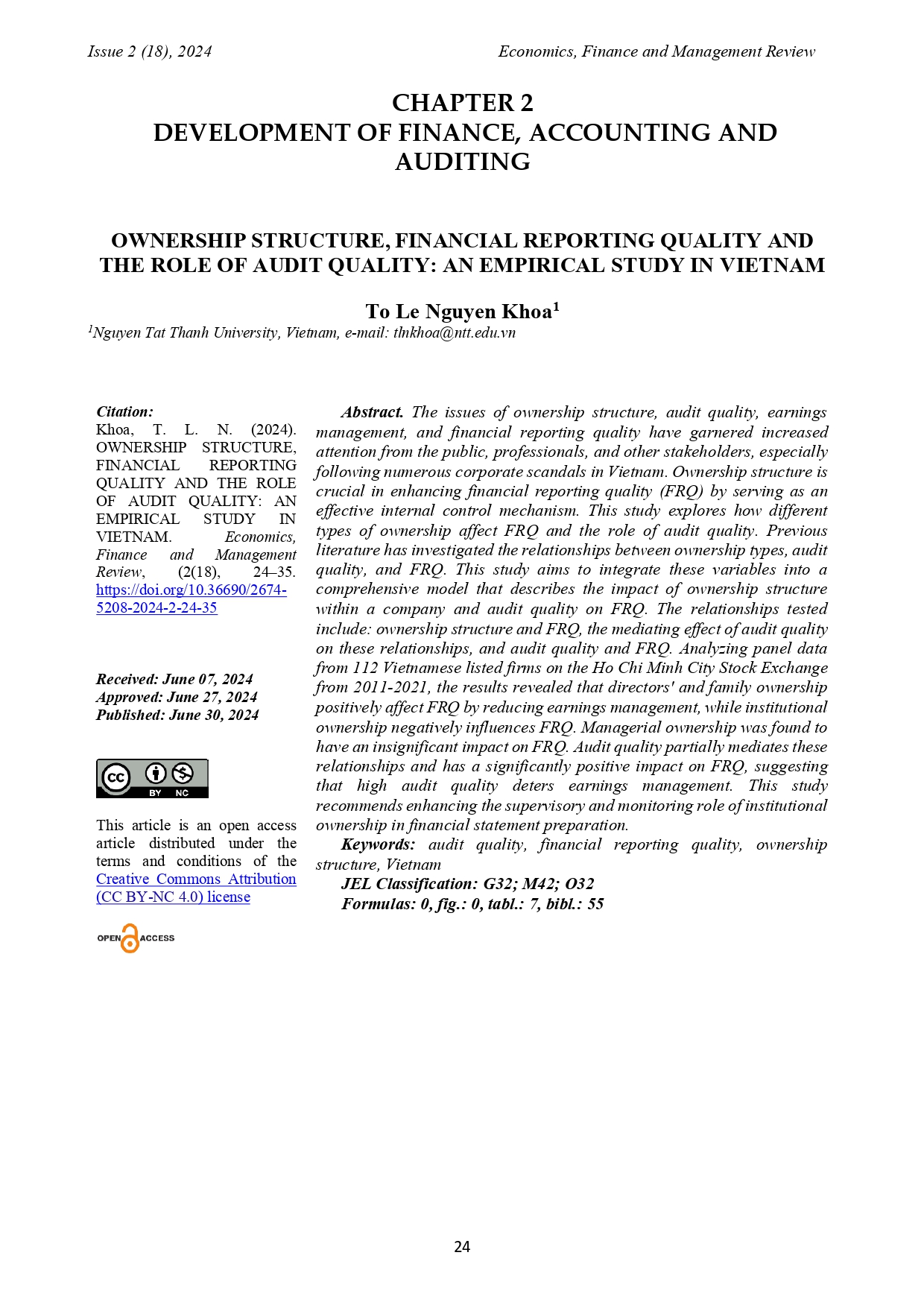
OWNERSHIP STRUCTURE, FINANCIAL REPORTING QUALITY AND THE ROLE OF AUDIT QUALITY: AN EMPIRICAL STUDY IN VIETNAM
DOI:
https://doi.org/10.36690/2674-5208-2024-2-24-35Keywords:
audit quality, financial reporting quality, ownership structure, VietnamAbstract
The issues of ownership structure, audit quality, earnings management, and financial reporting quality have garnered increased attention from the public, professionals, and other stakeholders, especially following numerous corporate scandals in Vietnam. Ownership structure is crucial in enhancing financial reporting quality (FRQ) by serving as an effective internal control mechanism. This study explores how different types of ownership affect FRQ and the role of audit quality. Previous literature has investigated the relationships between ownership types, audit quality, and FRQ. This study aims to integrate these variables into a comprehensive model that describes the impact of ownership structure within a company and audit quality on FRQ. The relationships tested include: ownership structure and FRQ, the mediating effect of audit quality on these relationships, and audit quality and FRQ. Analyzing panel data from 112 Vietnamese listed firms on the Ho Chi Minh City Stock Exchange from 2011-2021, the results revealed that directors' and family ownership positively affect FRQ by reducing earnings management, while institutional ownership negatively influences FRQ. Managerial ownership was found to have an insignificant impact on FRQ. Audit quality partially mediates these relationships and has a significantly positive impact on FRQ, suggesting that high audit quality deters earnings management. This study recommends enhancing the supervisory and monitoring role of institutional ownership in financial statement preparation.
Downloads
References
Al-Rassas, A. H., & Kamardin, H. (2015). Internal and external audit attributes, audit committee characteristics, ownership concentration and earnings quality: Evidence from Malaysia. Mediterranean Journal of Social Sciences, 6(3), 458.
Aljughaiman, A. A., Nguyen, T. H., Trinh, V. Q., & Du, A. (2023). The Covid-19 outbreak, corporate financial distress and earnings management. International Review of Financial Analysis, 88, 102675.
Almustafa, H., Nguyen, Q. K., Liu, J., & Dang, V. C. (2023). The impact of COVID-19 on firm risk and performance in MENA countries: Does national governance quality matter? PloS one, 18(2), e0281148.
Baker, T. A., Lopez, T. J., Reitenga, A. L., & Ruch, G. W. (2019). The influence of CEO and CFO power on accruals and real earnings management. Review of Quantitative Finance and Accounting, 52(1), 325-345.
Basheer, M. F., Gupta, S., Raoof, R., & Waemustafa, W. (2021). Revisiting the agency conflicts in family owned pyramidal business structures: A case of an emerging market. Cogent Economics & Finance, 9(1), 1926617.
Carey, P., Simnett, R., & Tanewski, G. (2000). Voluntary demand for internal and external auditing by family businesses. Auditing: A Journal of Practice & Theory, 19(s-1), 37-51.
Choi, H., & Byun, J. (2018). The relationship between corporate social responsibility and earnings management: accounting for endogeneity. Investment Management & Financial Innovations, 15(4), 69.
Dang, V. C., Le, T. L., Nguyen, Q. K., & Tran, D. Q. (2020). Linkage between exchange rate and stock prices: Evidence from Vietnam. The Journal of Asian Finance, Economics, and Business, 7(12), 95-107.
Dang, V. C., & Nguyen, Q. K. (2021a). Determinants of FDI attractiveness: Evidence from ASEAN-7 countries. Cogent Social Sciences, 7(1), 2004676.
Dang, V. C., & Nguyen, Q. K. (2021b). Internal corporate governance and stock price crash risk: evidence from Vietnam. Journal of Sustainable Finance & Investment, 1-18. doi:10.1080/20430795.2021.2006128
Dang, V. C., & Nguyen, Q. K. (2022). Audit committee characteristics and tax avoidance: Evidence from an emerging economy. Cogent Economics & Finance, 10(1), 2023263.
Dang, V. C., Nguyen, Q. K., & Tran, X. H. (2022). Corruption, institutional quality and shadow economy in Asian countries. Applied Economics Letters, 1-6.
Dobija, D., Hryckiewicz, A., Zaman, M., & Puławska, K. (2022). Critical mass and voice: Board gender diversity and financial reporting quality. European Management Journal, 40(1), 29-44.
Germain, L., Galy, N., & Lee, W. (2014). Corporate governance reform in Malaysia: Board size, independence and monitoring. Journal of Economics and Business, 75, 126-162.
Ho, T. T., Tran, X. H., & Nguyen, Q. K. (2023). Tax revenue-economic growth relationship and the role of trade openness in developing countries. Cogent Business & Management, 10(2), 2213959. doi:10.1080/23311975.2023.2213959
Jensen, M. C., & Meckling, W. H. (1976). Theory of the firm: Managerial behavior, agency costs and ownership structure. Journal of financial economics, 3(4), 305-360.
John, K., & Senbet, L. W. (1998). Corporate governance and board effectiveness. Journal of Banking & Finance, 22(4), 371-403.
Khai, N. Q. (2022). Corporate governance and bank risk in Asean countries. University of Economics Ho Chi Minh City.
Kim, E. H., & Lu, Y. (2011). CEO ownership, external governance, and risk-taking. Journal of financial economics, 102(2), 272-292.
Kouaib, A., & Jarboui, A. (2014). External audit quality and ownership structure: interaction and impact on earnings management of industrial and commercial Tunisian sectors. Journal of Economics Finance and Administrative Science, 19(37), 78-89.
Larcker, D. F., Richardson, S. A., & Tuna, I. r. (2007). Corporate governance, accounting outcomes, and organizational performance. The accounting review, 82(4), 963-1008.
Law, S. H., & Azman-Saini, W. N. W. (2012). Institutional quality, governance, and financial development. Economics of Governance, 13(3), 217-236. doi:10.1007/s10101-012-0112-z
Le, H. T. T., Tran, H. G., & Vo, X. V. (2021). Audit quality, accruals quality and the cost of equity in an emerging market: Evidence from Vietnam. International Review of Financial Analysis, 77, 101798.
Lin, J. W., & Hwang, M. I. (2010). Audit quality, corporate governance, and earnings management: A meta‐analysis. International Journal of Auditing, 14(1), 57-77.
Morris, J. J., & Laksmana, I. (2010). Measuring the impact of enterprise resource planning (ERP) systems on earnings management. Journal of Emerging Technologies in Accounting, 7(1), 47-71.
Mustapha, M., & Ahmad, A. C. (2011). Agency theory and managerial ownership: evidence from Malaysia. Managerial auditing journal, 26(5), 419-436.
Nguyen, Q., & Dang, V. (2020). Audit committee structure and bank stability in Vietnam. ACRN Journal of Finance and Risk Perspectives, 8(1), 240-255.
Nguyen, Q. K. (2020). Ownership structure and bank risk-taking in ASEAN countries: A quantile regression approach. Cogent Economics & Finance, 8(1), 1809789.
Nguyen, Q. K. (2021). Oversight of bank risk-taking by audit committees and Sharia committees: conventional vs Islamic banks. Heliyon, 7(8), e07798.
Nguyen, Q. K. (2022a). Audit committee effectiveness, bank efficiency and risk-taking: Evidence in ASEAN countries. Cogent Business & Management, 9(1), 2080622.
Nguyen, Q. K. (2022b). Audit committee structure, institutional quality, and bank stability: evidence from ASEAN countries. Finance Research Letters, 46, 102369.
Nguyen, Q. K. (2022c). Determinants of bank risk governance structure: A cross-country analysis. Research in International Business and Finance, 60, 101575. doi:https://doi.org/10.1016/j.ribaf.2021.101575
Nguyen, Q. K. (2022d). The impact of risk governance structure on bank risk management effectiveness: evidence from ASEAN countries. Heliyon, e11192.
Nguyen, Q. K. (2023a). Does the financial flexibility prevent stock price crash risk during COVID-19 crisis? Evidence from the Vietnamese stock market. Heliyon, 9(11).
Nguyen, Q. K. (2023b). Macroeconomic determinants of economic growth in low-and mid-income countries: new evidence using a non-parametric approach. Applied Economics Letters, 1-6.
Nguyen, Q. K. (2023c). Women in top executive positions, external audit quality and financial reporting quality: evidence from Vietnam. Journal of Accounting in Emerging Economies.
Nguyen, Q. K. (2024). How Does Financial Flexibility Strategy Impact on Risk Management Effectiveness? Sage Open, 14(2), 21582440241240842.
Nguyen, Q. K., & Dang, V. C. (2022a). Does the country’s institutional quality enhance the role of risk governance in preventing bank risk? Applied Economics Letters, 1-4.
Nguyen, Q. K., & Dang, V. C. (2022b). The Effect of FinTech Development on Financial Stability in an Emerging Market: The Role of Market Discipline. Research in Globalization, 100105.
Nguyen, Q. K., & Dang, V. C. (2023a). The impact of FinTech development on stock price crash risk and the role of corporate social responsibility: Evidence from Vietnam. Business Strategy & Development.
Nguyen, Q. K., & Dang, V. C. (2023b). Renewable energy consumption, carbon dioxide emission and financial stability: does institutional quality matter? Applied Economics, 1-18.
Nguyen, Q. K. (2024b). Globalization, Credit Information Sharing and Financial Stability in Developing Countries. Economic Change and Restructuring.
Paniagua, J., Rivelles, R., & Sapena, J. (2018). Corporate governance and financial performance: The role of ownership and board structure. Journal of Business Research, 89, 229-234.
Parte-Esteban, L., & García, C. F. (2014). The influence of firm characteristics on earnings quality. International Journal of Hospitality Management, 42, 50-60.
Powell, G. N., & Greenhaus, J. H. (2010). Sex, gender, and decisions at the family→ work interface. Journal of management, 36(4), 1011-1039.
Qiao, L., Adegbite, E., & Nguyen, T. H. (2023). Chief financial officer overconfidence and earnings management. Paper presented at the Accounting Forum.
Rashid, M. M. (2020). Ownership structure and firm performance: the mediating role of board characteristics. Corporate Governance: The International Journal of Business in Society, 20(4), 719-737.
Shehzad, C. T., de Haan, J., & Scholtens, B. (2010). The impact of bank ownership concentration on impaired loans and capital adequacy. Journal of Banking & Finance, 34(2), 399-408.
Srinidhi, B., Gul, F. A., & Tsui, J. (2011). Female directors and earnings quality. Contemporary Accounting Research, 28(5), 1610-1644.
Suprianto, E., Suwarno, S., Murtini, H., Rahmawati, R., & Sawitri, D. (2017). Audit Committee Accounting Expert and Earnings Management with “Status” Audit Committee as Moderating Variable. Indonesian Journal of Sustainability Accounting and Management, 1(2), 49-58.
Suto, M., & Takehara, H. (2020). Corporate social responsibility intensity, management earnings forecast accuracy, and investor trust: Evidence from Japan. Corporate Social Responsibility and Environmental Management, 27(6), 3047-3059.
Tandean, V. A., & Winnie, W. (2016). The effect of good corporate governance on tax avoidance: An empirical study on manufacturing companies listed in IDX period 2010-2013. Asian Journal of Accounting Research.
Ud Din, N., Cheng, X., Ahmad, B., Sheikh, M. F., Adedigba, O. G., Zhao, Y., & Nazneen, S. (2021). Gender diversity in the audit committee and the efficiency of internal control and financial reporting quality. Economic research-Ekonomska istraživanja, 34(1), 1170-1189.
Wang, B. (2018). Ownership, institutions and firm value: Cross-provincial evidence from China. Research in International Business and Finance, 44, 547-565. doi:https://doi.org/10.1016/j.ribaf.2017.07.125
Weir, C., & Laing, D. (2001). Governance structures, director independence and corporate performance in the UK. European Business Review, 13(2), 86-95.
Downloads
Published
How to Cite
Issue
Section
License

This work is licensed under a Creative Commons Attribution-NonCommercial 4.0 International License.