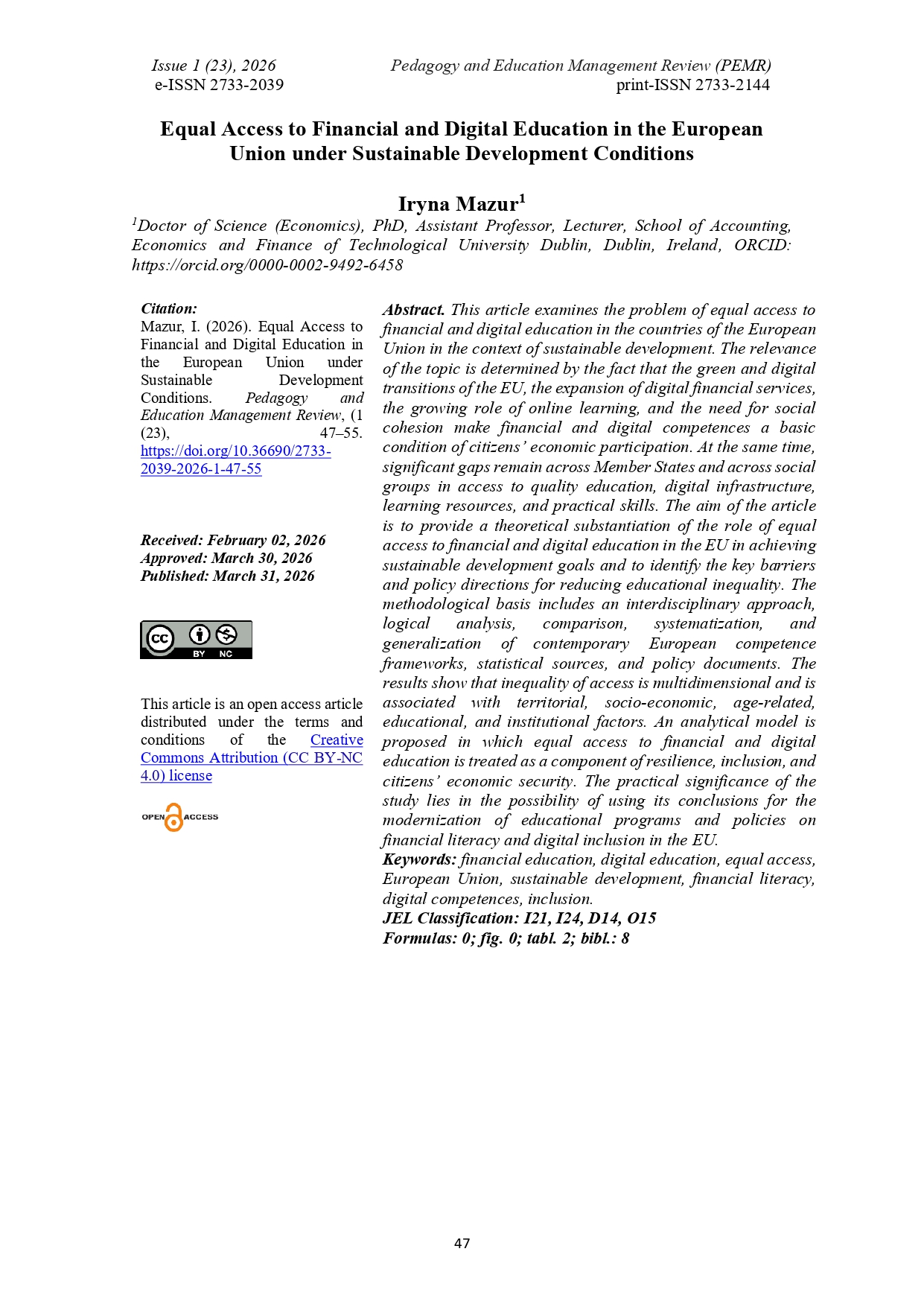
Equal Access to Financial and Digital Education in the European Union under Sustainable Development Conditions
DOI:
https://doi.org/10.36690/2733-2039-2026-1-47-55Keywords:
financial education, digital education, equal access, European Union, sustainable development, financial literacy, digital competences, inclusionAbstract
This article examines the problem of equal access to financial and digital education in the countries of the European Union in the context of sustainable development. The relevance of the topic is determined by the fact that the green and digital transitions of the EU, the expansion of digital financial services, the growing role of online learning, and the need for social cohesion make financial and digital competences a basic condition of citizens’ economic participation. At the same time, significant gaps remain across Member States and across social groups in access to quality education, digital infrastructure, learning resources, and practical skills. The aim of the article is to provide a theoretical substantiation of the role of equal access to financial and digital education in the EU in achieving sustainable development goals and to identify the key barriers and policy directions for reducing educational inequality. The methodological basis includes an interdisciplinary approach, logical analysis, comparison, systematization, and generalization of contemporary European competence frameworks, statistical sources, and policy documents. The results show that inequality of access is multidimensional and is associated with territorial, socio-economic, age-related, educational, and institutional factors. An analytical model is proposed in which equal access to financial and digital education is treated as a component of resilience, inclusion, and citizens’ economic security. The practical significance of the study lies in the possibility of using its conclusions for the modernization of educational programs and policies on financial literacy and digital inclusion in the EU.
Downloads
References
European Commission. (2021). Digital Education Action Plan 2021–2027. European Commission. https://education.ec.europa.eu/focus-topics/digital-education/actions
European Commission. (2023a). Monitoring the level of financial literacy in the EU (Flash Eurobarometer 525). European Commission. https://europa.eu/eurobarometer/surveys/detail/2953
European Commission. (2023b). TSI 2024 Flagship: Digital Financial Literacy. European Commission. https://reform-support.ec.europa.eu/tsi-2024-flagship-digital-financial-literacy_en
Eurostat. (2025a). Skills for the digital age. Eurostat. https://ec.europa.eu/eurostat/statistics-explained/index.php?title=Skills_for_the_digital_age
Eurostat. (2025b). Digitalisation in Europe – 2025 edition. Eurostat. https://ec.europa.eu/eurostat/web/interactive-publications/digitalisation-2025
Eurostat. (2025c). Digital society statistics at regional level. Eurostat. https://ec.europa.eu/eurostat/statistics-explained/index.php?title=Digital_society_statistics_at_regional_level
OECD. (2022). Financial competence framework for adults in the European Union. OECD Publishing. https://www.oecd.org/en/publications/financial-competence-framework-for-adults-in-the-european-union_510f133c-en.html
OECD. (2023). Financial competence framework for children and youth in the European Union. OECD Publishing. https://www.oecd.org/en/publications/financial-competence-framework-for-children-and-youth-in-the-european-union_bf059471-en.html
Downloads
Published
How to Cite
Issue
Section