Digital Competences of Professionals in Security and Fraud Prevention
DOI:
https://doi.org/10.36690/2733-2039-2026-1-22-32Keywords:
digital competences, cybersecurity, fraud prevention, anti-fraud, security professionals, digital literacy, cyber resilience, professional trainingAbstract
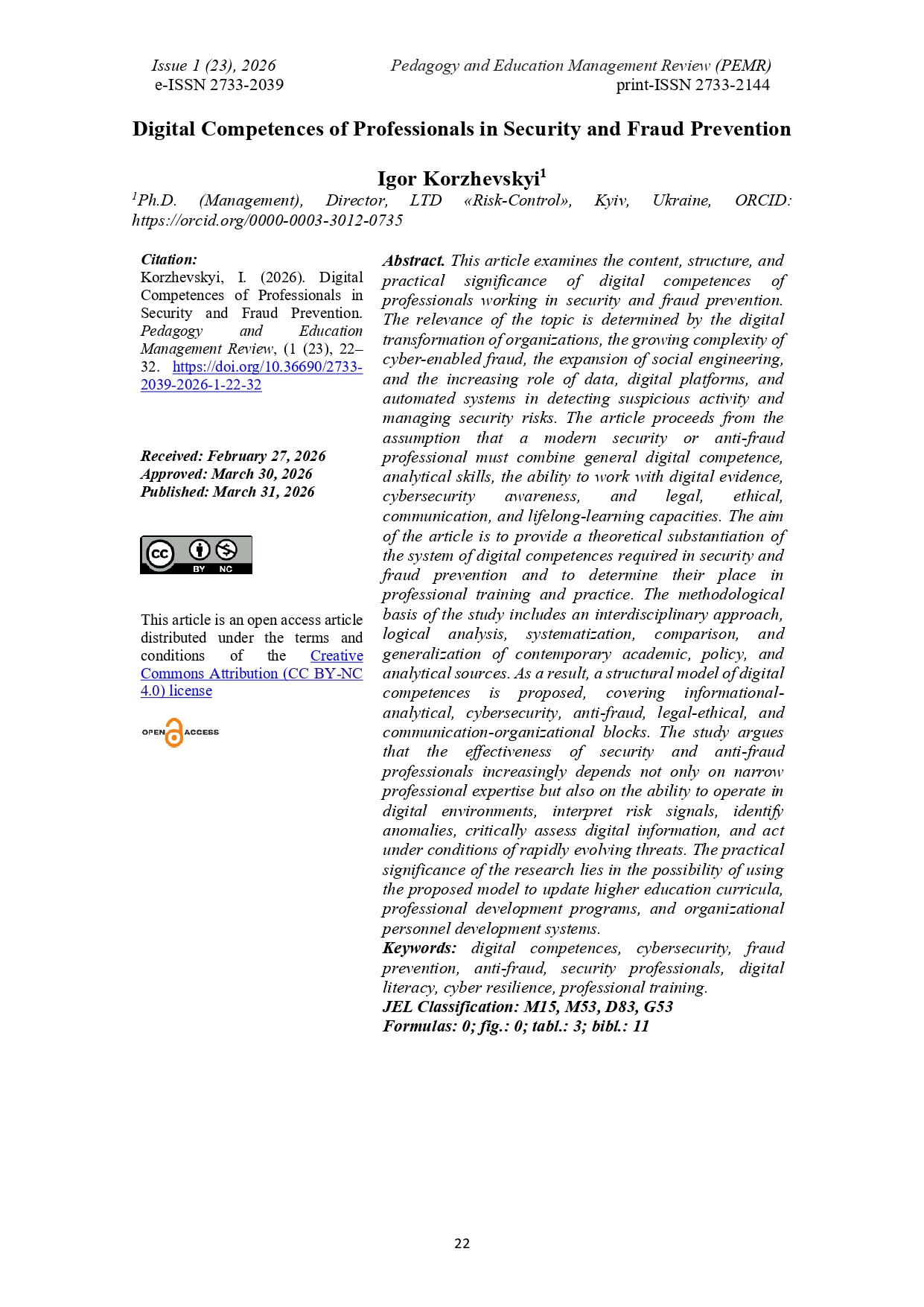
This article examines the content, structure, and practical significance of digital competences of professionals working in security and fraud prevention. The relevance of the topic is determined by the digital transformation of organizations, the growing complexity of cyber-enabled fraud, the expansion of social engineering, and the increasing role of data, digital platforms, and automated systems in detecting suspicious activity and managing security risks. The article proceeds from the assumption that a modern security or anti-fraud professional must combine general digital competence, analytical skills, the ability to work with digital evidence, cybersecurity awareness, and legal, ethical, communication, and lifelong-learning capacities. The aim of the article is to provide a theoretical substantiation of the system of digital competences required in security and fraud prevention and to determine their place in professional training and practice. The methodological basis of the study includes an interdisciplinary approach, logical analysis, systematization, comparison, and generalization of contemporary academic, policy, and analytical sources. As a result, a structural model of digital competences is proposed, covering informational-analytical, cybersecurity, anti-fraud, legal-ethical, and communication-organizational blocks. The study argues that the effectiveness of security and anti-fraud professionals increasingly depends not only on narrow professional expertise but also on the ability to operate in digital environments, interpret risk signals, identify anomalies, critically assess digital information, and act under conditions of rapidly evolving threats. The practical significance of the research lies in the possibility of using the proposed model to update higher education curricula, professional development programs, and organizational personnel development systems.
Downloads
References
Association of Certified Fraud Examiners. (2024). Occupational fraud 2024: A report to the nations. ACFE. https://www.acfe.com/-/media/files/acfe/pdfs/rttn/2024/2024-report-to-the-nations.pdf
ENISA. (2022). European Cybersecurity Skills Framework (ECSF). European Union Agency for Cybersecurity. https://www.enisa.europa.eu/publications/european-cybersecurity-skills-framework-ecsf
ENISA. (2022). European Cybersecurity Skills Framework role profiles. European Union Agency for Cybersecurity. https://shorturl.at/fjFxt
ENISA. (2022). European Cybersecurity Skills Framework user manual. European Union Agency for Cybersecurity. https://shorturl.at/eV0v3
European Commission. (2025). Digital skills. Shaping Europe’s Digital Future. https://digital-strategy.ec.europa.eu/en/policies/digital-skills
European Commission. (2025). Digital skills initiatives. Shaping Europe’s Digital Future. https://digital-strategy.ec.europa.eu/en/policies/digital-skills-initiatives
Europol. (2025). Online fraud schemes. Europol. https://www.europol.europa.eu/crime-areas/online-fraud-schemes
National Institute of Standards and Technology. (2020). Workforce Framework for Cybersecurity (NICE Framework) (NIST SP 800-181 Rev. 1). NIST. https://doi.org/10.6028/NIST.SP.800-181r1
National Institute of Standards and Technology. (2025). NICE Framework current versions. NIST. https://shorturl.at/SfWNc
Vuorikari, R., Kluzer, S., & Punie, Y. (2022). DigComp 2.2: The Digital Competence Framework for Citizens. Publications Office of the European Union. https://doi.org/10.2760/115376
World Economic Forum. (2025). The Future of Jobs Report 2025. World Economic Forum. https://reports.weforum.org/docs/WEF_Future_of_Jobs_Report_2025.pdf
Downloads
Published
How to Cite
Issue
Section