Ethical AI in Education: Principles, Governance, and Responsible Implementation
DOI:
https://doi.org/10.36690/2733-2039-2025-4-17-30Keywords:
ethical AI, education governance, learner rights, transparency, explainability, fairness, privacy, academic integrity, accountability, generative AI, risk management, child centered designAbstract
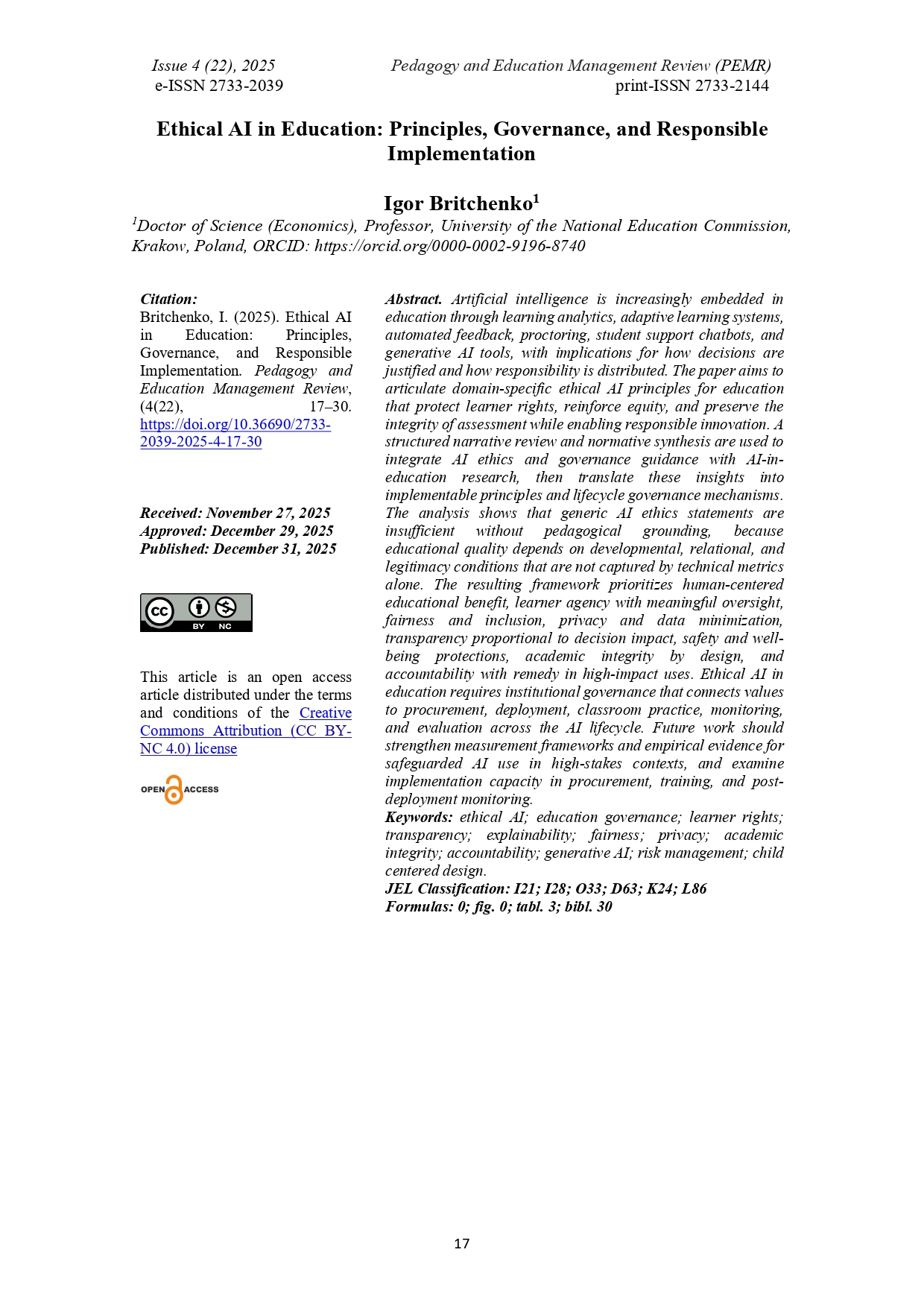
Artificial intelligence is increasingly embedded in education through learning analytics, adaptive learning systems, automated feedback, proctoring, student support chatbots, and generative AI tools, with implications for how decisions are justified and how responsibility is distributed. The paper aims to articulate domain-specific ethical AI principles for education that protect learner rights, reinforce equity, and preserve the integrity of assessment while enabling responsible innovation. A structured narrative review and normative synthesis are used to integrate AI ethics and governance guidance with AI-in-education research, then translate these insights into implementable principles and lifecycle governance mechanisms. The analysis shows that generic AI ethics statements are insufficient without pedagogical grounding, because educational quality depends on developmental, relational, and legitimacy conditions that are not captured by technical metrics alone. The resulting framework prioritizes human-centered educational benefit, learner agency with meaningful oversight, fairness and inclusion, privacy and data minimization, transparency proportional to decision impact, safety and well-being protections, academic integrity by design, and accountability with remedy in high-impact uses. Ethical AI in education requires institutional governance that connects values to procurement, deployment, classroom practice, monitoring, and evaluation across the AI lifecycle. Future work should strengthen measurement frameworks and empirical evidence for safeguarded AI use in high-stakes contexts, and examine implementation capacity in procurement, training, and post-deployment monitoring.
Downloads
References
Council of Europe. (2024, September 5). Council of Europe Framework Convention on Artificial Intelligence and Human Rights, Democracy and the Rule of Law. (CETS No. 225). Council of Europe. https://rm.coe.int/1680afae3c rm.coe.int
Council of Europe. (2024). Council of Europe Framework Convention on Artificial Intelligence and human rights, democracy and the rule of law (CETS No. 225). https://rm.coe.int/1680afae3c
European Commission. (2019). Ethics guidelines for trustworthy AI. https://digital-strategy.ec.europa.eu/en/library/ethics-guidelines-trustworthy-ai
European Union. (2024). Regulation (EU) 2024/1689 of the European Parliament and of the Council of 13 June 2024 laying down harmonised rules on artificial intelligence (Artificial Intelligence Act). Official Journal of the European Union. https://eur-lex.europa.eu/eli/reg/2024/1689/oj/eng
European Union. (2024). Regulation (EU) 2024/1689 of the European Parliament and of the Council of 13 June 2024 laying down harmonised rules on artificial intelligence (Artificial Intelligence Act). Official Journal of the European Union. https://eur-lex.europa.eu/legal-content/EN/TXT/PDF/?uri=OJ%3AL_202401689
European Union. (2024). Regulation (EU) 2024/1689 of the European Parliament and of the Council of 13 June 2024 laying down harmonised rules on artificial intelligence and amending Regulations (EC) No 300/2008, (EU) No 167/2013, (EU) No 168/2013, (EU) 2018/858, (EU) 2018/1139 and (EU) 2019/2144 and Directives 2014/90/EU, (EU) 2016/797 and (EU) 2020/1828 (Artificial Intelligence Act). Official Journal of the European Union. https://eur-lex.europa.eu/eli/reg/2024/1689/oj/eng EUR-Lex
European Union. (2024). Regulation (EU) 2024/1689 of the European Parliament and of the Council of 13 June 2024 laying down harmonised rules on artificial intelligence (Artificial Intelligence Act). Official Journal of the European Union. https://eur-lex.europa.eu/eli/reg/2024/1689/oj/eng EUR-Lex
High-Level Expert Group on Artificial Intelligence. (2019). Ethics guidelines for trustworthy AI. European Commission. https://digital-strategy.ec.europa.eu/en/library/ethics-guidelines-trustworthy-ai digital-strategy.ec.europa.eu
Holmes, W., Porayska-Pomsta, K., Holstein, K., Sutherland, E., Baker, T., Santos, O. C., Rodrigo, M. M. T., Cukurova, M., Bittencourt, I. I., & Koedinger, K. R. (2022). Ethics of AI in education: Towards a community-wide framework. International Journal of Artificial Intelligence in Education, 32(3), 504-526. https://doi.org/10.1007/s40593-021-00239-1
Ifenthaler, D., & Schumacher, C. (2016). Student perceptions of privacy principles for learning analytics. Educational Technology Research and Development, 64(5), 923-938. https://doi.org/10.1007/s11423-016-9477-y
Jisc. (2016). Jisc’s learning analytics code of practice. https://community.jisc.ac.uk/system/files/391/LA%20and%20Ethics%20v0-16.pdf
Jisc. (2023). Code of practice for learning analytics (July 2023 ed.). Jisc. https://repository.jisc.ac.uk/9204/1/code-of-practice-for-learning-analytics.pdf repository.jisc.ac.uk
Miao, F., & Holmes, W. (2023). Guidance for generative AI in education and research. UNESCO. https://unesdoc.unesco.org/ark:/48223/pf0000386693
National Institute of Standards and Technology. (2023). Artificial Intelligence Risk Management Framework (AI RMF 1.0) (NIST AI 100-1). https://nvlpubs.nist.gov/nistpubs/ai/nist.ai.100-1.pdf
Organisation for Economic Co-operation and Development. (2019). Recommendation of the Council on Artificial Intelligence (OECD/LEGAL/0449). https://legalinstruments.oecd.org/en/instruments/oecd-legal-0449
Organisation for Economic Co-operation and Development. (2019). Recommendation of the Council on Artificial Intelligence (OECD/LEGAL/0449). OECD. https://legalinstruments.oecd.org/api/print?ids=648&lang=en OECD Legal Instruments
Reiss, M. J. (2021). The use of AI in education: Practicalities and ethical considerations. London Review of Education, 19(1), Article 5, 1-14. https://doi.org/10.14324/LRE.19.1.05
Selwyn, N. (2022). The future of AI and education: Some cautionary notes. European Journal of Education, 57(4), 620-631. https://doi.org/10.1111/ejed.12532
Slade, S., & Prinsloo, P. (2013). Learning analytics: Ethical issues and dilemmas. American Behavioral Scientist, 57(10), 1509-1528. https://doi.org/10.1177/0002764213479366
U.S. Department of Education, Office of Educational Technology. (2023). Artificial intelligence and the future of teaching and learning: Insights and recommendations. https://www.ed.gov/sites/ed/files/documents/ai-report/ai-report.pdf
UNESCO. (2021). AI and education: Guidance for policy-makers. https://unesdoc.unesco.org/ark:/48223/pf0000376709
UNESCO. (2021). Recommendation on the Ethics of Artificial Intelligence. https://unesdoc.unesco.org/ark:/48223/pf0000380455
UNESCO. (2021/2022). Recommendation on the Ethics of Artificial Intelligence (SHS/BIO/PI/2021/1). https://unesdoc.unesco.org/ark:/48223/pf0000381137.locale=en
UNESCO. (2023). Guidance for generative AI in education and research. https://www.unesco.org/en/articles/guidance-generative-ai-education-and-research
UNICEF. (2025). Guidance on AI and children (Version 3.0): Recommendations for AI policies and systems that uphold children’s rights. UNICEF Innocenti. https://www.unicef.org/innocenti/media/11991/file/UNICEF-Innocenti-Guidance-on-AI-and-Children-3-2025.pdf
Williamson, B., & Eynon, R. (2020). Historical threads, missing links, and future directions in AI in education. Learning, Media and Technology, 45(3), 223–235. https://doi.org/10.1080/17439884.2020.1798995
Zawacki-Richter, O., Marín, V. I., Bond, M., & Gouverneur, F. (2019). Systematic review of research on artificial intelligence applications in higher education: Where are the educators? International Journal of Educational Technology in Higher Education, 16, Article 39. https://doi.org/10.1186/s41239-019-0171-0
Downloads
Published
How to Cite
Issue
Section