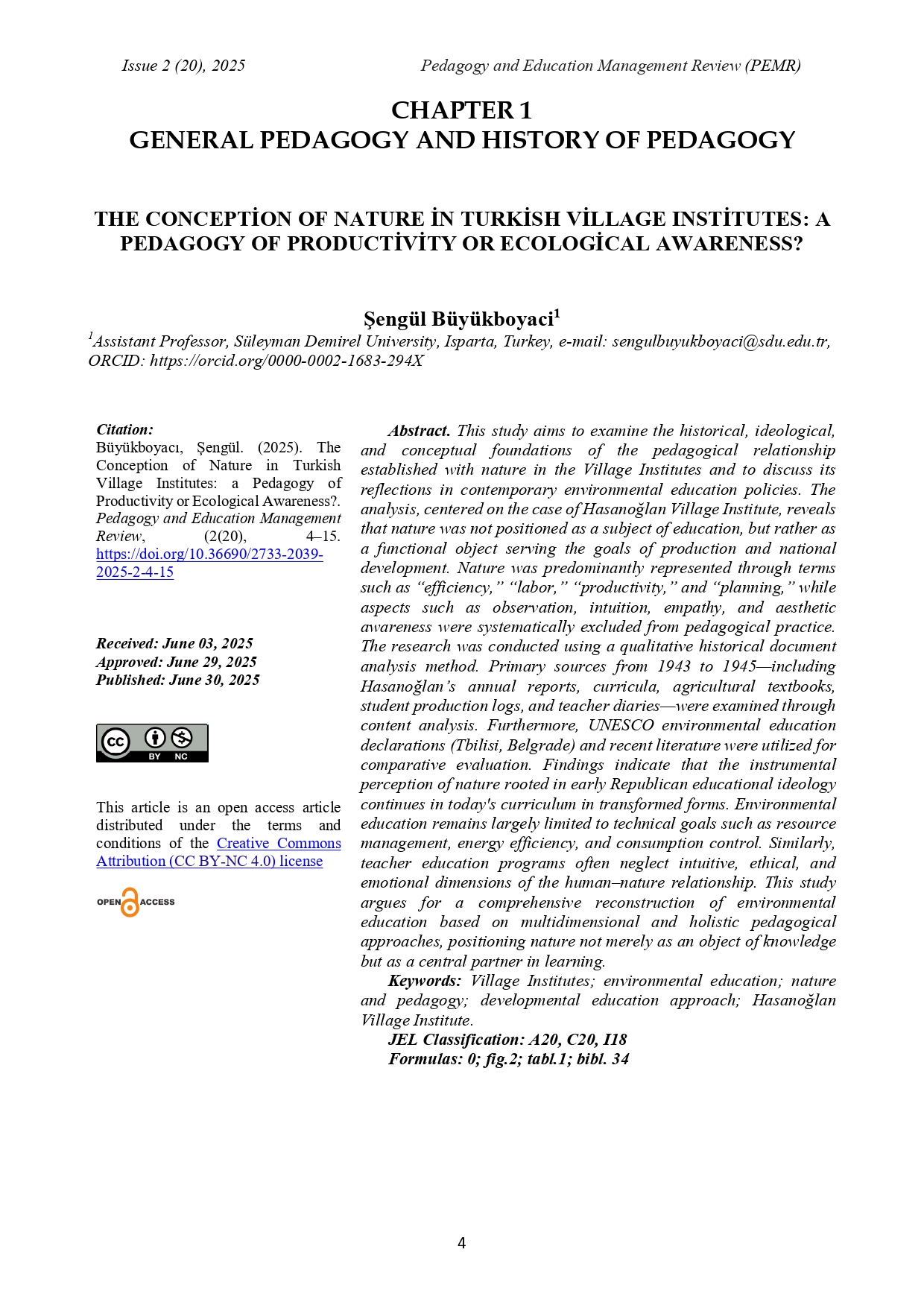
THE CONCEPTİON OF NATURE İN TURKİSH VİLLAGE INSTİTUTES: A PEDAGOGY OF PRODUCTİVİTY OR ECOLOGİCAL AWARENESS?
DOI:
https://doi.org/10.36690/2733-2039-2025-2-4-15Keywords:
Village Institutes, environmental education, nature and pedagogy, developmental education, Hasanoğlan Village InstituteAbstract
Abstract. This study examines the historical, ideological, and conceptual foundations of the pedagogical relationship established with nature in the Village Institutes and discusses its implications for contemporary environmental education policies. The analysis, centered on the case of Hasanoğlan Village Institute, reveals that nature was positioned not as a subject of education but rather as a functional element serving production and development goals. Nature was predominantly represented through concepts such as “efficiency,” “labor,” “productivity,” and “planning,” while aspects such as observation, intuition, empathy, and aesthetic awareness were marginalized. The research was conducted using a qualitative historical document analysis method. The primary sources include the Village Institutes Law No. 3803, scholarly studies on the Hasanoğlan Higher Village Institute, instructional programs of the period, as well as UNESCO environmental education documents (Belgrade Charter, 1975; Tbilisi Declaration, 1978). In addition, recent environmental education literature was utilized for comparative evaluation. Findings indicate that the developmental and instrumental perception of nature rooted in early Republican educational ideology persists in today’s curricula in transformed forms. Environmental education remains largely confined to technical objectives such as resource management, energy efficiency, and consumption control. Similarly, teacher education programs tend to neglect intuitive, ethical, and emotional dimensions of the human–nature relationship. The study concludes that environmental education should be reconstructed based on multidimensional and holistic pedagogical approaches, positioning nature not merely as an object of knowledge but as a central partner in learning.
Downloads
References
Altunya, N., & Kınacı, S. (2018). Hasanoğlan Higher Village Institute. Tonguç Archive Publications.
Baş, E., & Ercan, R. (2023). A descriptive analysis of the curricula implemented in Village Institutes. International Journal of Social, Humanities and Administrative Sciences, 9(61), 2354–2365. https://doi.org/10.29228/JOSHAS.68257
Burgaç, M. (2009). The principle and outcomes of productive work education in Çifteler Village Institute. In Proceedings of the Symposium on Our Educational Heritage: Village Institutes, Their Applicability and Model Studies (17–18 April 2008). Istanbul: Literatür Publishing.
Dalkılıç, M., Erbaşı, A., & Erbaşı, S. (2024). A study on high school students’ levels of environmental awareness, environmental anxiety, and environmental attitudes. Boğaziçi University Journal of Education, 41(1), 1–23.
Dewey, J. (1938). Experience and education. New York: Macmillan Company.
Gökdemir, T. (2019). Hasanoğlan Village Institute in the context of Turkish educational history (Master’s thesis, Kahramanmaraş Sütçü İmam University, Institute of Social Sciences).
Gülersoy, A. E., Dülger, İ., Dursun, E., Ay, D., & Duyal, D. (2020). What kind of environmental education? Some suggestions within the framework of contemporary approaches. Turkish Studies, 15(5), 2357–2398. https://doi.org/10.7827/TurkishStudies.44074
Illich, I. (1971). Deschooling society. New York: Harper & Row.
Ministry of National Education [MoNE]. (2018). Science curriculum (Grades 3–8). Ankara: Board of Education and Discipline.
Mutlu, A., & Yaşar, M. N. (2025). Village Institutes and the Akpınar Village Institute library as a national opportunity for sustainable environmental ethics. Journal of Economics, Business, Politics and International Relations (JEBPIR), 11(1), 101–121.
Ontario Ministry of Education. (2007). Shaping our schools, shaping our future: Environmental education policy framework. Toronto: Queen’s Printer for Ontario.
Serter, N. (2007). Human-centred education in the 21st century. Istanbul: Nesnel Publishing.
Sobel, D. (2004). Place-based education: Connecting classrooms and communities. Barrington, MA: Orion Society.
Sterling, S. (2001). Sustainable education: Re-visioning learning and change. Totnes: Green Books.
Turkish Grand National Assembly. (1940, April 22). Village Institutes Law (Law No. 3803). Official Gazette.
UNESCO. (1975). The Belgrade Charter: A global framework for environmental education. Paris: UNESCO.
UNESCO. (1978). Tbilisi Declaration: Intergovernmental Conference on Environmental Education. Paris: UNESCO.
Yalçın, G. (2009). An original model of higher education: The Higher Village Institutes. In Proceedings of the Symposium on Our Educational Heritage: Village Institutes, Their Applicability and Model Studies (17–18 April 2008). Istanbul: Literatür Publishing.
Yalçın, G. (2012). The revitalised utopia: Village Institutes. Istanbul: E Publishing.
Yıldız, N., & Akandere, O. (2017). The ideological structure of the Village Institutes. Journal of Modern Turkish History Studies, 17(35), 233–274.
Yılmaz, A. (2009). Production and nutrition in Çifteler Village Institute. In Proceedings of the Symposium on Our Educational Heritage: Village Institutes, Their Applicability and Model Studies (17–18 April 2008). Istanbul: Literatür Publishing.
Yüksel, S. (2009). Daily life and cultural activities in the Village Institutes. Education and Science, 34(151), 45–59. http://www.politikadergisi.com/makale/cumhuriyetin-eserleri-arasinda-en-kiymetlisi-koy-enstituleri
Downloads
Published
How to Cite
Issue
Section