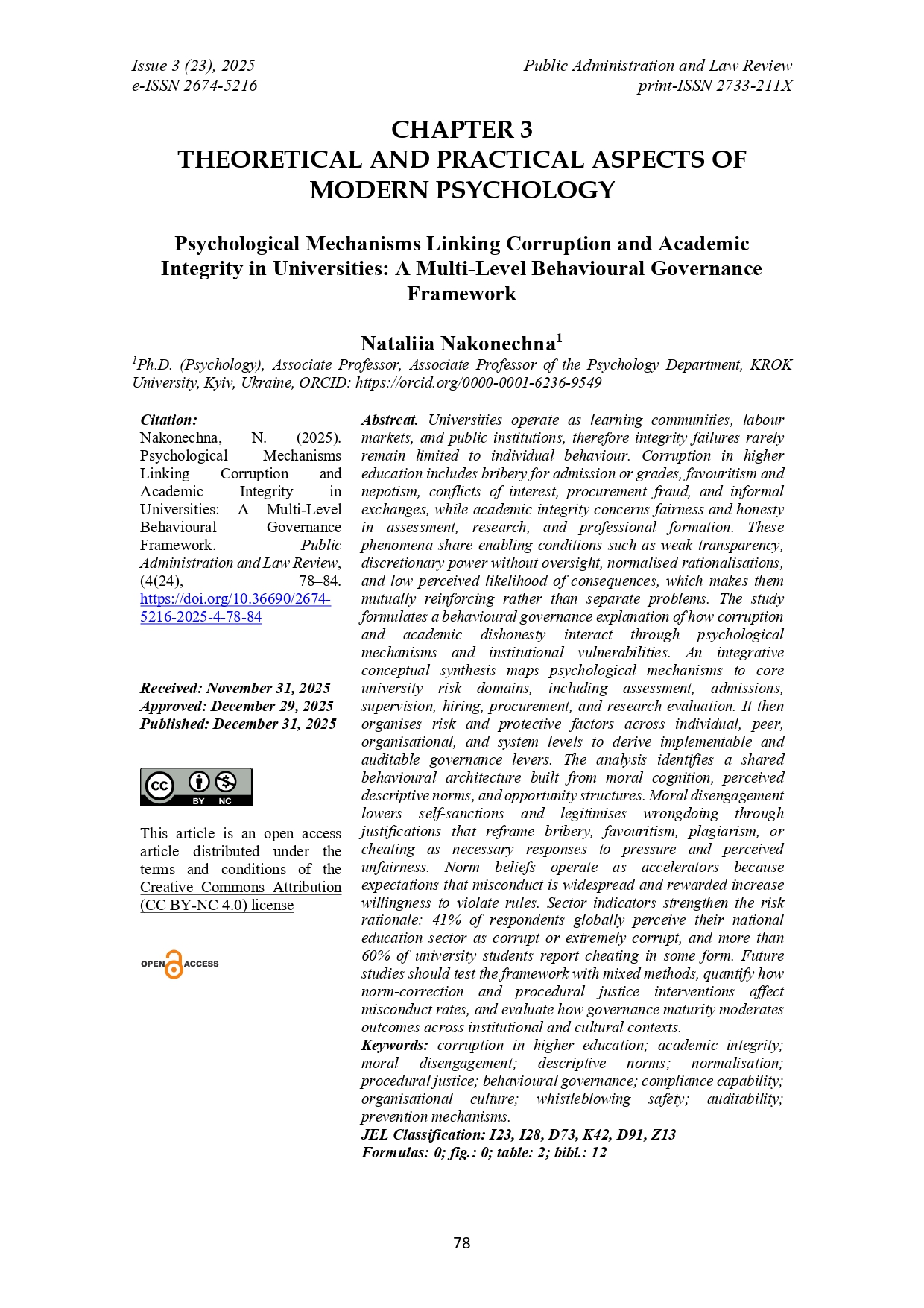
Psychological Mechanisms Linking Corruption and Academic Integrity in Universities: A Multi-Level Behavioural Governance Framework
DOI:
https://doi.org/10.36690/2674-5216-2025-4-78-84Keywords:
corruption in higher education, academic integrity, moral disengagement, descriptive norms, normalisation, procedural justice, behavioural governance, compliance capability, organisational culture, whistleblowing safety, auditability, prevention mechanismsAbstract
Universities operate as learning communities, labour markets, and public institutions, therefore integrity failures rarely remain limited to individual behaviour. Corruption in higher education includes bribery for admission or grades, favouritism and nepotism, conflicts of interest, procurement fraud, and informal exchanges, while academic integrity concerns fairness and honesty in assessment, research, and professional formation. These phenomena share enabling conditions such as weak transparency, discretionary power without oversight, normalised rationalisations, and low perceived likelihood of consequences, which makes them mutually reinforcing rather than separate problems. The study formulates a behavioural governance explanation of how corruption and academic dishonesty interact through psychological mechanisms and institutional vulnerabilities. An integrative conceptual synthesis maps psychological mechanisms to core university risk domains, including assessment, admissions, supervision, hiring, procurement, and research evaluation. It then organises risk and protective factors across individual, peer, organisational, and system levels to derive implementable and auditable governance levers. The analysis identifies a shared behavioural architecture built from moral cognition, perceived descriptive norms, and opportunity structures. Moral disengagement lowers self-sanctions and legitimises wrongdoing through justifications that reframe bribery, favouritism, plagiarism, or cheating as necessary responses to pressure and perceived unfairness. Norm beliefs operate as accelerators because expectations that misconduct is widespread and rewarded increase willingness to violate rules. Sector indicators strengthen the risk rationale: 41% of respondents globally perceive their national education sector as corrupt or extremely corrupt, and more than 60% of university students report cheating in some form. Future studies should test the framework with mixed methods, quantify how norm-correction and procedural justice interventions affect misconduct rates, and evaluate how governance maturity moderates outcomes across institutional and cultural contexts.
Downloads
References
Ashforth, B. E., & Anand, V. (2003). The normalization of corruption in organizations. Research in Organizational Behavior, 25, 1–52. https://www.sciencedirect.com/science/article/pii/S0191308503250012
Bandura, A. (1999). Moral disengagement in the perpetration of inhumanities. Personality and Social Psychology Review, 3(3), 193–209. https://pubmed.ncbi.nlm.nih.gov/15661671/
Council for Higher Education Accreditation, & UNESCO International Institute for Educational Planning. (2016). Advisory statement for effective international practice: Combatting corruption and enhancing integrity: A contemporary challenge for the quality and credibility of higher education. https://www.chea.org/sites/default/files/pdf/Combatting%20Academic%20Corruption%20and%20Enhancing%20Integrity.pdf
Council of Europe. (2024). Corruption in education (Factsheet). https://rm.coe.int/factsheet-corruption-in-education/1680b1c631
International Center for Academic Integrity. (2025). Facts & statistics. https://academicintegrity.org/aws/ICAI/pt/sp/facts
Moore, C. (2008). Moral disengagement in processes of organizational corruption. Journal of Business Ethics, 80(1), 129–139. https://link.springer.com/article/10.1007/s10551-007-9447-8
Organisation for Economic Co-operation and Development. (2018). Integrity of education systems: A methodology for sector assessment (INTES). https://www.oecd.org/content/dam/oecd/en/publications/reports/2018/01/integrity-of-education-systems_da1cd38c/ef327353-en.pdf
Transparency International. (2013). Global corruption report: Education. https://www.corruptionwatch.org.za/wp-content/uploads/migrated/2013_GCR_Education.pdf
Transparency International. (2025). Topic guide: Corruption in education. https://knowledgehub.transparency.org/guide/topic-guide-on-corruption-in-education/4488
UNESCO International Institute for Educational Planning. (2025). ETICO: Academic integrity. https://etico.iiep.unesco.org/en/academic-integrity
Zhao, H., Zhang, H., & Xu, Y. (2019). Effects of perceived descriptive norms on corrupt intention: The mediating role of moral disengagement. International Journal of Psychology. https://pubmed.ncbi.nlm.nih.gov/28139097/
Zhao, L., Mao, H., Compton, B. J., Peng, J., Fu, G., Heyman, G. D., & Lee, K. (2022). Academic dishonesty and its relations to peer cheating and culture: A meta-analysis of the perceived peer cheating effect. Educational Research Review, 36, 100455. https://www.sciencedirect.com/science/article/pii/S1747938X22000240
Downloads
Published
How to Cite
Issue
Section
License

This work is licensed under a Creative Commons Attribution-NoDerivatives 4.0 International License.