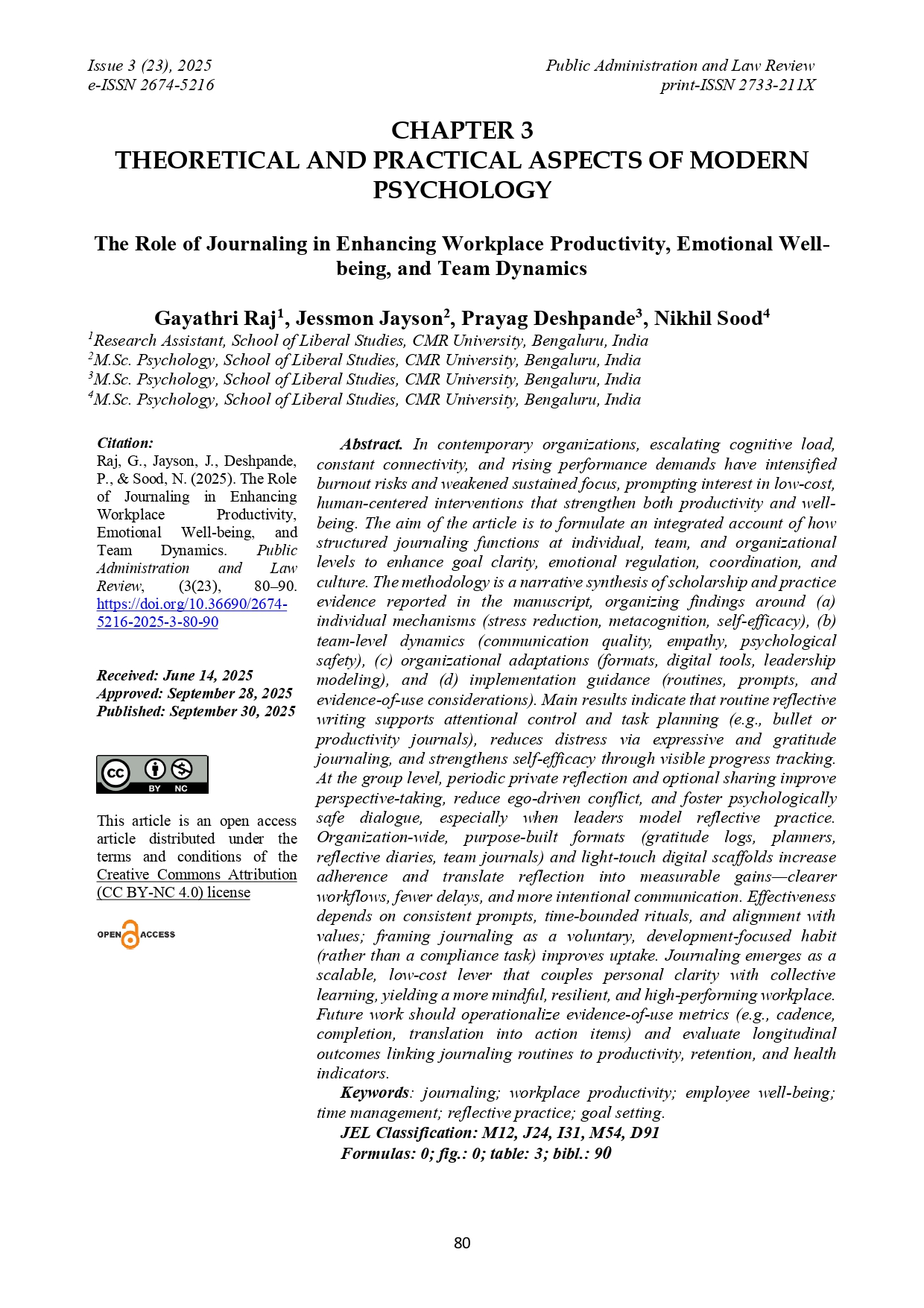
The Role of Journaling in Enhancing Workplace Productivity, Emotional Well-being, and Team Dynamics
DOI:
https://doi.org/10.36690/2674-5216-2025-3-80-90Keywords:
journaling, workplace productivity, employee well-being, time management, reflective practice, goal settingAbstract
In contemporary organizations, escalating cognitive load, constant connectivity, and rising performance demands have intensified burnout risks and weakened sustained focus, prompting interest in low-cost, human-centered interventions that strengthen both productivity and well-being. The aim of the article is to formulate an integrated account of how structured journaling functions at individual, team, and organizational levels to enhance goal clarity, emotional regulation, coordination, and culture. The methodology is a narrative synthesis of scholarship and practice evidence reported in the manuscript, organizing findings around (a) individual mechanisms (stress reduction, metacognition, self-efficacy), (b) team-level dynamics (communication quality, empathy, psychological safety), (c) organizational adaptations (formats, digital tools, leadership modeling), and (d) implementation guidance (routines, prompts, and evidence-of-use considerations). Main results indicate that routine reflective writing supports attentional control and task planning (e.g., bullet or productivity journals), reduces distress via expressive and gratitude journaling, and strengthens self-efficacy through visible progress tracking. At the group level, periodic private reflection and optional sharing improve perspective-taking, reduce ego-driven conflict, and foster psychologically safe dialogue, especially when leaders model reflective practice. Organization-wide, purpose-built formats (gratitude logs, planners, reflective diaries, team journals) and light-touch digital scaffolds increase adherence and translate reflection into measurable gains—clearer workflows, fewer delays, and more intentional communication. Effectiveness depends on consistent prompts, time-bounded rituals, and alignment with values; framing journaling as a voluntary, development-focused habit (rather than a compliance task) improves uptake. Journaling emerges as a scalable, low-cost lever that couples personal clarity with collective learning, yielding a more mindful, resilient, and high-performing workplace. Future work should operationalize evidence-of-use metrics (e.g., cadence, completion, translation into action items) and evaluate longitudinal outcomes linking journaling routines to productivity, retention, and health indicators.
Downloads
References
Aishwarya, D., Gangotri, L., & Saranya, T. S. (2024). Leveraging AI Tools for Personalized and Optimized Addiction Treatment: A New Frontier in Mental Health Care. Journal of Environmental Agriculture and Agroecosystem Management, 1(1), 69-73.
Alhasani, M., & Orji, R. (2025). Promoting stress management among students in higher education: Evaluating the effectiveness of a persuasive time management mobile app. International Journal of Human–Computer Interaction, 41(1), 219-241. https://doi.org/10.1080/10447318.2023.2297330
Anderson, D. M., & Stritch, J. M. (2016). Goal clarity, task significance, and performance: Evidence from a laboratory experiment. Journal of Public Administration Research and Theory, 26(2), 211-225.https://doi.org/10.1093/jopart/muv019
Aristova, I., Zapara, S., Rohovenko, O., Serohina, N., Matviienko, L., & Gupta, S. K. (2021). Some aspects of legal regulation of administrative procedures in Ukraine and the European Union: theory and realities.
Babu, S., Binoy, B., & Saranya, T. S. (2024). A Comparative Study on Self-Efficacy and Emotional Intelligence Among Day Scholars and Boarding Students. Journal of Humanistic Studies and Social Dynamics, 1(2), 12-18.
Bajaj, N., Satheesh, N., Sreedharan, A., & Saranya, T. S. (2024). Loneliness and Risk-Taking Behaviour Among Young Adolescents Who Are Staying Away from Their Family and Young Adolescents Who Are Staying with Their Family. Journal of Humanistic Studies and Social Dynamics, 1(01), 59-68. DOI: https://doi.org/10.70903/7mbj2b46
Bandura, A. (2023). Cultivate self‐efficacy for personal and organizational effectiveness. Principles of Organizational Behavior: The Handbook of Evidence‐Based Management 3rd Edition, 113-135. https://doi.org/10.1002/9781394320769.ch6
Banka, S., Madan, I., & Saranya, S. S. (2018). Smart healthcare monitoring using IoT. International Journal of Applied Engineering Research, 13(15), 11984-11989. DOI: https://doi.org/10.70903/g2hva883
Bharmal, A., Bharmal, S., & Saranya, T. S. (2024, November). Blockchain-Powered Personalized Stress Reduction Platform: Integrating IoT, Neuroadaptive Technology, And Biohacking Protocols. In International Conference on economics, accounting and finance-2024.
Burton, C.M., & King, L.A. (2016). Effects of one week of writing on health and mood. British Journal of Health Psychology, 13(1), 9–14. DOI: 10.1348/135910707X250910
Carton, A. M., Murphy, C., & Clark, J. R. (2014). A (blurry) vision of the future: How leader rhetoric about ultimate goals influences performance. Academy of Management Journal, 57(6), 1544-1570. https://doi.org/10.5465/amj.2012.0101
Castelli, P. A. (2016). Reflective leadership review: A framework for improving organisational performance. Journal of Management Development, 35(2), 217-236. Castelli, P. A. (2016). Reflective leadership review: A framework for improving organisational performance. Journal of Management Development, 35(2), 217-236.
Chase, J. A. D., Topp, R., Smith, C. E., Cohen, M. Z., Fahrenwald, N., Zerwic, J. J., ... & Conn, V. S. (2013). Time management strategies for research productivity. Western journal of nursing research, 35(2), 155-176. https://doi.org/10.1177/0193945912451163
Deb, S. (2022). Introduction—child safety, welfare, and well-being: need of the hour. In Child Safety, Welfare and Well-being: Issues and Challenges (pp. 1-13). Singapore: Springer Singapore. DOI: https://doi.org/10.1007/978-981-16-9820-0
Dong, R. K., & Li, X. (2024). Psychological safety and psychosocial safety climate in workplace: A bibliometric analysis and systematic review towards a research agenda. Journal of Safety Research, 91, 1-19. https://doi.org/10.1016/j.jsr.2024.08.001
Doshi, M., & Saranya, T. S. (2024). Musical Preference and Stress Among Young Adults. Journal of Humanistic Studies and Social Dynamics, 1(01), 53-58. DOI: https://doi.org/10.70903/z2pedp85
Edmondson, A. (1999). Psychological safety and learning behavior in work teams. Administrative Science Quarterly, 44(2):350–383.DOI: 10.2307/2666999
Frazier, M.L., T. Fainshmidt, R. Klinger, A. Pezeshkan & V. Vracheva. (2017). Psychological safety: A meta-analytic review and extension. Personnel Psychology. DOI: 10.1111/peps.12183
Gregory, A., Pereira, N., & Saranya, T. S. (2024). A Meta Analytical Review of the Effectiveness of Physical Exercises to Reduce the Build Up of Amyloid Protein.
Gregory, A., Saranya, T. S., & Pereira, N. (2024). Frontal Lobe Dementia: The Integration of AI Technology for the Diagnosis and Management. Journal of Humanistic Studies and Social Dynamics, 1(01), 69-83. DOI: https://doi.org/10.70903/qh06nj89
Gupta, S. K., & Saranya, T. S. (2024). Navigating the Digital Frontier: The Unique Challenges and Opportunities of Education in India. Pedagogy and education management review, (4 (18)), 4-24. DOI: https://doi.org/10.36690/2733-2039-2024-4-24
Gupta, S. K., Dubey, C., Weersma, L. A., Vats, R., Rajesh, D., Oleksand, K., & Ratan, R. (2023). Competencies for the academy and market perspective: an approach to the un-sustainable development goals. Int. J. Exp. Res. Rev, 32, 70-88. DOI: https://doi.org/10.52756/ijerr.2023.v32.005
Gupta, S. K., Gupta, R., Srivastava, V., & Gopal, R. The Digitalisation of The Monetary system in India: Challenges and Significance for Economic Development. Journal of Emerging Technologies and Innovative Research, March, 2109, 01-04.
Gupta, S. K., Karpa, M. I., Derhaliuk, M. O., Tymkova, V. A., & Kumar, R. (2020). Effectiveness vs efficiency for organisational development: a study. Journal of Talent Development and Excellence, 12(3s), 2478-2486.
Harvey, J. F., Johnson, K. J., Roloff, K. S., & Edmondson, A. C. (2019). From orientation to behavior: The interplay between learning orientation, open-mindedness, and psychological safety in team learning. Human Relations, 72(11), 1726-1751. https://doi.org/10.1177/0018726718817812
Jerusha, E., & Saranya, T. S. (2024). Ai-Driven Behavioural Cues for Preventing Cannabis Relapse: A New Era in Addiction Recovery.
Khanna, P., & Singh, K. (2021). Stress management training and gratitude journaling in the classroom: an initial investigation in Indian context. Current Psychology, 40(11), 5737-5748. https://doi.org/10.1007/s12144-020-01242-w
Klockner, K. (2018). Strategically Developing a Resilient Safety Culture: Organizational Mindfulness and Mindful Organizing. In: Arezes, P. (eds) Advances in Safety Management and Human Factors. AHFE 2017. Advances in Intelligent Systems and Computing, vol 604. Springer, Cham. https://doi.org/10.1007/978-3-319-60525-8_12
Komarraju, M., Swanson, J., & Nadler, D. (2014). Increased career self-efficacy predicts college students’ motivation, and course and major satisfaction. Journal of Career Assessment, 22(3), 420-432. https://doi.org/10.1177/1069072713498484
Komase, Y., Watanabe, K., Hori, D., Nozawa, K., Hidaka, Y., Iida, M., Imamura, K., & Kawakami, N. (2021). Effects of gratitude intervention on mental health and well-being among workers: A systematic review. Journal of occupational health, 63(1), e12290. https://doi.org/10.1002/1348-9585.12290
Krishna, A., NK, S. R., & Saranya, T. S. (2024). Understanding the Relationship Between Verbal Aggression and Social Withdrawal in Adolescents. Journal of Humanistic Studies and Social Dynamics, 1(01), 13-19. DOI: https://doi.org/10.70903/8zp5vf45
Kumar, N. S., Kapoor, S., & Gupta, s. K. (2021). Is employee gratification the same as employee engagement? -an in-depth theory perspective. AD ALTA: journal of interdisciplinary research, 11(2).
Kumar, V., Mishra, P., Yadav, s. B., & Gupta, S. K. (2023). The role of power dynamics and social status in Indian MNCs in shaping ingroup and out-group behaviour and its impact on perceived individual performance outcomes. AD ALTA: journal of interdisciplinary research, 13(1).
Levytska, S., Akimova, L., Zaiachkivska, O., Karpa, M., & Gupta, S. K. (2020). Modern analytical instruments for controlling the enterprise financial performance. Financial and credit activity problems of theory and practice, 2(33), 314-323. DOI: https://doi.org/10.18371/fcaptp.v2i33.206967
McGuire, K. M. B., Greenberg, M. A., & Gevirtz, R. (2005). Autonomic effects of expressive writing in individuals with elevated blood pressure. Journal of Health Psychology, 10(2), 197-209.
https://doi.org/10.1177/1359105305049767
McGuire KM, Greenberg MA, Gevirtz R. Autonomic effects of expressive writing in individuals with elevated blood pressure. J Health Psychol. 2005 Mar;10(2):197-209. doi: 10.1177/1359105305049767.
Melarisisha, M., & Saranya, T. S. Effectiveness of Solution-focused Brief Therapy (SFBT) on Academic Stress and Procrastination on Young Adults. International Journal of Health Sciences, (III), 5040-5049. DOI: 10.53730/ijhs.v6nS3.7006
Moffatt-Bruce, S. D., Nguyen, M. C., Steinberg, B., Holliday, S., & Klatt, M. (2019). Interventions to reduce burnout and improve resilience: impact on a health system’s outcomes. Clinical obstetrics and gynecology, 62(3), 432-443. DOI: 10.1097/GRF.0000000000000458
Mogård, E. V., Rørstad, O. B., & Bang, H. (2022). The relationship between psychological safety and management team effectiveness: the mediating role of behavioral integration. International journal of environmental research and public health, 20(1), 406. https://doi.org/10.3390/ijerph20010406
Nigesh, K., & Saranya, T. S. (2017). A Comprehensive Review: Dementia Management and Rehabilitation. Global Journal of Addiction & Rehabilitation Medicine, 3(2), 39-52.
Nigesh, K., & Saranya, T. S. (2017). Existential Therapies: Theoretical basis, Process, Application and Empirical Evidences. International Journal of Education and Psychological.
Obrenovic, B., Jianguo, D., Khudaykulov, A., & Khan, M. A. S. (2020). Work-family conflict impact on psychological safety and psychological well-being: A job performance model. Frontiers in psychology, 11, 475.https://doi.org/10.3389/fpsyg.2020.00475
Patil, M. R., Raj, G., Sadanandan, A., & Saranya, T. S. (2024, December). Understanding Autism Spectrum Disorder: A Social Studies Perspective. In Relationship between public administration and business entities management-2024.
Pegu, B., Srinivas, B. H., Saranya, T. S., Murugesan, R., Thippeswamy, S. P., & Gaur, B. P. S. (2020). Cervical polyp: evaluating the need of routine surgical intervention and its correlation with cervical smear cytology and endometrial pathology: a retrospective study. Obstetrics & Gynecology Science, 63(6), 735-742. DOI: https://doi.org/10.5468/ogs.20177
Pitiulych, M., Hoblyk, V., Sherban, T., Tovkanets, G., Kravchenko, T., & Gupta, S. K. (2020). A sociological monitoring of youth migration movement.
Preetha, D. V., Pratheeksha, P., & Vamshitha, G. (2024). Insta-Tangles: Exploring The Web of Instagram Addiction, Fomo, Perceived Stress, And Self-Esteem. Library Progress International, 44(3), 14130-14144. DOI: https://doi.org/10.48165/bapas.2024.44.2.1
Rana, R., Kapoor, S., & Gupta, S. K. (2021). Impact of HR practices on corporate image building in the Indian IT sector. Problems and Perspectives in Management, 19(2), 528-535.
Saranya, T. S., & Deb, S. (2015). Resilience capacity and support function of Paniya Tribal Adolescents in Kerala and its association with demographic variables. Int. J. Indian Psychol, 2, 75-87.
Saranya, T. S., & Nigesh, K. (2017). Risk taking behavior among adolescents: An exploratory study. The International Journal of Indian Psychology, 4(4), 70-77. DOI: 10.25215/0404.027
Saranya, T. S., Deb, S., Paul, D., & Deb, S. (2022). Untold and Painful Stories of Survival: The Life of Adolescent Girls of the Paniya Tribes of Kerala, India. In Child Safety, Welfare and Well-being: Issues and Challenges (pp. 185-194). Singapore: Springer Singapore. DOI: https://doi.org/10.1007/978-981-16-9820-0_11
Saranya, T. S., Sreelatha, K., & Kumar, M. (2022). The pain of existence: The problems and crisis of transgender people with special emphasis on discrimination and livelihood. International journal of health sciences, (II), 8031-8041. DOI: 10.53730/ijhs.v6nS2.7011
Saranya, T. S. (2017). Perceived parental care and support services and its relationship with mental health of Paniya Adolescents (Doctoral dissertation, Department of Applied Psychology, PU.).
Schunk, D. H. (1995). Self-efficacy, motivation, and performance. Journal of applied sport psychology, 7(2), 112-137. https://doi.org/10.1080/10413209508406961
Sharma, R., Mohan, M., & Gupta, S. K. (2023). Emotions in retail setting: a systematic literature review based on current research. International Journal of Experimental Research and Review, 30, 416-432. DOI: https://doi.org/10.52756/ijerr.2023.v30.039
Sinha, H., Mishra, P., Lakhanpal, P., & Gupta, S. K. (2022). Entrepreneur preparedness to the development of probable successors in entrepreneurial organization: scale development and validation. AD ALTA: journal of interdisciplinary research, 12(2). DOI: 10.33543/1202186192
Sinha, H., Mishra, P., Lakhanpal, P., & Gupta, s. K. (2022). Human resource practice types being followed in Indian entrepreneurial organizations with focus on Succession Planning Process. AD ALTA: Journal of Interdisciplinary Research, 12(2). DOI: 10.33543/12025359
Smyth, A. P., Werner, K. M., Milyavskaya, M., Holding, A., & Koestner, R. (2020). Do mindful people set better goals? Investigating the relation between trait mindfulness, self-concordance, and goal progress. Journal of Research in Personality, 88, 104015. https://doi.org/10.1016/j.jrp.2020.104015
Smyth, J. M., Johnson, J. A., Auer, B. J., Lehman, E., Talamo, G., & Sciamanna, C. N. (2018). Online positive affect journaling in the improvement of mental distress and well-being in general medical patients with elevated anxiety symptoms: A preliminary randomized controlled trial. JMIR mental health, 5(4), e11290. https://doi.org/10.2196/11290
Susmitha, T. S., & Saranya, T. S. (2024). Uncovering Emotions: Using IoT as a Psychodiagnostics Tool. International Journal of Indian Psychology, 12(3). DOI: 10.25215/1203.161
Swathi, M., Shajil, S., Mohamed, S. K., Dsa, N. P., & Saranya, T. S. (2024). MEDIA: The Powerful Cognitive and Social Architect to Rebuild the Personality and Self. Journal of Humanistic Studies and Social Dynamics, 1(2), 1-11.DOI: https://doi.org/10.70903/yyczvw60
Tan, T. T., Tan, M. P., Lam, C. L., Loh, E. C., Capelle, D. P., Zainuddin, S. I., ... & Tan, S. B. (2021). Mindful gratitude journaling: psychological distress, quality of life and suffering in advanced cancer: a randomised controlled trial. BMJ Supportive & Palliative Care, 13(e2), e389-e396. https://doi.org/10.1136/bmjspcare-2021-003068
Tripathi, A., & Saranya, T. S. Issues and Challenges of Adults with Hearing Disability: A Mixed-method Study to Compare the Deaf and Non-Deaf Adults on Social Adjustment. International Journal of Health Sciences, (III), 5032-5039. DOI: 10.53730/ijhs.v6nS3.7005
TS, Saranya, Gayathri Raj, Kevimeno Kiso, Darisha Kharmih, Kiniholi Yepthomi, Gimcule Thou, Sidhanth Ashok, Ashalatha TL, and Arsha Maria Benno. "Art in the Abyss: Creativity and the Schizophrenic Mind." Frontiers in Psychiatry 16: 1617462.
TS, S., Naila, P., & Langam, L. (2023). Managing Premenstrual Symptoms (PMS) Using Cognitive Therapy Interventions: A Systematic Review. International Neurourology Journal, 27(4), 1606-1612. DOI: 10.5123/inj.2023.3. inj184
Van der Hoek, M., Groeneveld, S., & Kuipers, B. (2018). Goal setting in teams: Goal clarity and team performance in the public sector. Review of public personnel administration, 38(4), 472-493. https://doi.org/10.1177/0734371X16682815
Varghese, A. S., Binoy, B., & Saranya, T. S. (2024, November). Smart Performance Management: Leveraging IoT and AI for Continuous Improvement. In International Conference on economics, accounting and finance-2024. DOI: https://doi.org/10.70903/mxqfkk22
Varghese, A. S., Navaneeth, P., & Saranya, T. S. (2024). Social Anxiety Among Male and Female Adults: A Comparative Study. Journal of Humanistic Studies and Social Dynamics, 1(01). DOI: https://doi.org/10.70903/mxqfkk22
Vercio, C., Loo, L. K., Green, M., Kim, D. I., & Beck Dallaghan, G. L. (2021). Shifting focus from burnout and wellness toward individual and organizational resilience. Teaching and learning in medicine, 33(5), 568-576. https://doi.org/10.1080/10401334.2021.1879651
Vishnoi, S., Priya, L., & Saranya, T. S. (2024, November). A Triadic Approach to Creativity Evaluation: AI, IoT, And Blockchain Synergy. In International Conference on economics, accounting and finance-2024.DOI: 10.36690/ICEAF-2024
Zulfikar, W., Chiaravalloti, T., Shen, J., Picard, R., & Maes, P. (2025). Resonance: Drawing from Memories to Imagine Positive Futures through AI-Augmented Journaling. arXiv preprint arXiv:2503.24145. https://doi.org/10.48550/arXiv.2503.24145
Downloads
Published
How to Cite
Issue
Section
License

This work is licensed under a Creative Commons Attribution-NoDerivatives 4.0 International License.